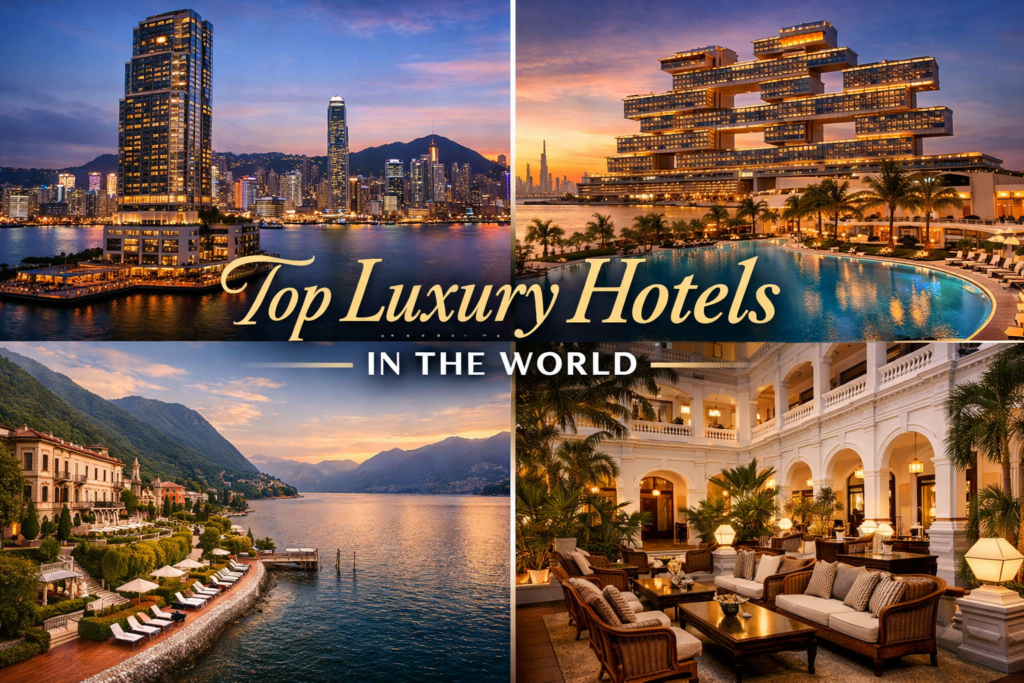
What Defines a True Luxury Hotel in 2026
A luxury hotel is no longer just a building with marble floors, designer chandeliers, and a famous address. In 2026, the best luxury hotels in the world are judged by something much harder to fake: how a stay makes a guest feel from the first greeting to the final goodbye. The modern high-end traveler expects personalized service, frictionless check-in, exceptional sleep quality, discreet privacy, outstanding food, spa credibility, and a sense that every detail was anticipated before it was requested. That expectation is not imagined. Forbes Travel Guide says its inspectors evaluate properties against up to 900 objective criteria, with hotel inspections based on real stays of at least two nights, which helps explain why truly elite hospitality remains rare even among expensive properties. In its current 2026 framework, Forbes Travel Guide still positions itself as the only independent global rating system focused on luxury hotels, restaurants, spas, and cruises, covering more than 2,100 properties in 90 countries.
That matters because price alone has never been a reliable signal of quality. A room can be costly and still feel generic, while a genuinely great five-star hotel turns comfort into theater without becoming performative. The best properties blend emotional intelligence with operational discipline. Staff remember preferences without sounding scripted. Housekeeping feels invisible yet precise. Architecture tells a story about place rather than simply showing off a budget. When travelers search for best luxury resorts, private villa hotels, fine dining hotels, or wellness hotels, they are often searching for one thing in disguise: confidence. They want to know that the property will deliver at a world-class level every single day. That is why the strongest hotel brands and the most admired independent properties continue to dominate global attention. In luxury hospitality, reputation is not wallpaper. It is accumulated proof.
Why Global Luxury Hotels Matter More Than Ever
The appetite for premium travel is not slowing down. UN Tourism reported that international tourist arrivals grew by 4% in 2025 to an estimated 1.52 billion, and the organization expects tourism to grow another 3% to 4% in 2026 if recovery continues, particularly across Asia and the Pacific. At the same time, Grand View Research estimates the global luxury travel market reached about USD 1.59 trillion in 2025 and projects strong long-term expansion, while the luxury hotel market itself was valued at USD 110.87 billion in 2025 with continued growth expected through 2033. These numbers matter for publishers, advertisers, and hospitality brands alike because luxury travel, premium credit cards, wealth management, private aviation, travel insurance, fine jewelry, and high-end wellness all compete for the same affluent audience. That is exactly why this topic attracts premium advertising value.
Yet the real story is not just volume. It is intention. Hilton’s 2026 trends research argues that travelers are increasingly choosing trips based on purpose before destination, describing this shift as the rise of the “whycation.” The same research also notes that 74% of travelers say it is valuable to engage with hotel brands they already know and trust, while family and multi-generational travel patterns are reshaping room preferences and amenity expectations. In plain language, travelers want more than a beautiful suite and a photogenic breakfast. They want a reason to go, a memory to bring home, and a hotel that feels aligned with that reason. That is why the world’s best luxury hotels are becoming less like static monuments and more like finely tuned ecosystems: part sanctuary, part cultural gateway, part status symbol, and part emotional reset button.
The World’s Most Admired Luxury Hotels Right Now
If you want a current snapshot of elite hospitality, one of the strongest global references is The World’s 50 Best Hotels list. Its 2025 ranking places Rosewood Hong Kong at No. 1, followed by Four Seasons Bangkok at Chao Phraya River at No. 2, Capella Bangkok at No. 3, Passalacqua at No. 4, Raffles Singapore at No. 5, and Atlantis The Royal at No. 6. That ranking alone tells a fascinating story about modern luxury. Asia remains exceptionally strong. Urban luxury is thriving. Heritage still matters. Waterfront settings continue to win. And hotels that combine strong design identity with deeply choreographed service are outperforming properties that rely on brand aura alone. The list is not merely decorative content for travel enthusiasts. It reflects where global influence is concentrating in hospitality right now.
Take Rosewood Hong Kong, for example. It represents the current ideal of urban luxury: enormous views, high-touch service, world-class dining, polished residential-style interiors, and a location that places the guest inside one of Asia’s most powerful financial and cultural hubs. Four Seasons Bangkok at Chao Phraya River and Capella Bangkok show a different route to excellence. Both use the river not simply as scenery, but as atmosphere. They create a rare sense of calm inside one of the world’s most dynamic cities. Passalacqua in Lake Como speaks to another luxury instinct entirely. It is intimate rather than vast, cinematic rather than corporate, and emotionally textured in a way that makes guests feel they are staying inside a dream that happens to have excellent concierge service. The modern luxury traveler does not always want the biggest property. Quite often, they want the property with the strongest soul.
Legendary Luxury Hotels That Continue to Set the Standard
Some luxury hotels are fashionable for a season. Others become part of hospitality mythology. Raffles Singapore remains one of the clearest examples of a hotel that preserves historical identity without feeling trapped by it. Its position in the 2025 World’s 50 Best Hotels ranking confirms that legacy still matters when it is paired with rigorous upkeep and contemporary relevance. The same is true in a different register for Mandarin Oriental Bangkok, ranked No. 7, which has long been treated as one of the gold standards of old-school Asian hospitality. These hotels do not sell novelty as their main proposition. They sell continuity, polish, confidence, and a kind of time-tested elegance that newer properties are still trying to imitate.
Then there is Atlantis The Royal in Dubai, a property that proves luxury does not have to whisper to be credible. Sometimes it can arrive like a fireworks show. Its recognition on global ranking lists and by Forbes Travel Guide reflects how well it translates scale into spectacle without losing service discipline. Forbes Travel Guide’s 2025 awards highlighted a global field of 336 Five-Star hotels across a list spanning more than 2,100 properties in 90 countries, which shows just how selective the top tier really is. Even more telling, Forbes’ 2025 coverage noted that cities such as London continued to deepen their concentration of Five-Star hospitality, while regions such as the Middle East and Asia kept expanding their influence. Luxury is no longer defined by Europe alone. The map has widened, and the competition has become much sharper.
A Quick Comparison of Elite Luxury Hotels
| Hotel | Location | Current Distinction | Best For |
|---|---|---|---|
| Rosewood Hong Kong | Hong Kong | No. 1 on The World’s 50 Best Hotels 2025 | Urban luxury, dining, harbor views |
| Four Seasons Bangkok at Chao Phraya River | Bangkok | No. 2 on The World’s 50 Best Hotels 2025 | Riverside calm, design, business-leisure travel |
| Capella Bangkok | Bangkok | No. 3 on The World’s 50 Best Hotels 2025 | Privacy, bespoke service, refined serenity |
| Passalacqua | Lake Como | No. 4 on The World’s 50 Best Hotels 2025 | Romance, boutique luxury, classic Italian glamour |
| Raffles Singapore | Singapore | No. 5 on The World’s 50 Best Hotels 2025 | Heritage luxury, iconic service, historic prestige |
| Atlantis The Royal | Dubai | No. 6 on The World’s 50 Best Hotels 2025 | Ultra-modern spectacle, family luxury, destination dining |
| Mandarin Oriental Bangkok | Bangkok | No. 7 on The World’s 50 Best Hotels 2025 | Traditional excellence, riverside elegance, spa culture |
Source data for rankings is drawn from the official 2025 list by The World’s 50 Best Hotels.
How Top Luxury Hotels Create Unforgettable Guest Experiences
What separates a memorable luxury resort from a merely expensive one? The answer is orchestration. Great luxury hotels understand that hospitality is cumulative. A guest remembers the mattress, yes, but also the scent in the hallway, the pacing of room service, the lighting near the vanity mirror, the noise level at breakfast, the emotional temperature of the front desk, and whether the spa feels healing or simply decorative. This is where the best hotels earn their premium. They do not merely offer amenities. They shape mood. In a world saturated by visual sameness, experience design has become the real battleground. That is why the finest hotels invest so deeply in wellness travel, private dining, signature suites, butler service, curated local experiences, and architecture that frames silence as a luxury asset rather than empty space.
This point is especially relevant in 2026 because consumer signals are shifting toward meaning, stillness, and trust. Hilton’s trends research describes a search for comfort, control, and connection, while one of its 2026 themes, “Hushpitality,” highlights growing interest in quiet, restorative travel experiences. Simon Vincent of Hilton summarized the broader mood by saying that travel remains a top priority, with people seeking more meaning in each trip. That observation explains why leading properties increasingly elevate rituals that might once have seemed small: a tea program with storytelling, a bath drawn to preference, a wellness consultation before arrival, a pillow menu that actually matters, a family suite that feels elegant rather than compromised, or a private transfer that begins the emotional tone of the stay before the lobby appears. Luxury today feels less like excess for its own sake and more like precision with emotional intelligence.
Why Silence, Space, and Ritual Matter
Silence has become one of the most underrated luxury products on earth. In mass-market travel, almost everything is optimized for throughput. In top-tier hospitality, the goal is different. The best hotels make time feel elastic. They reduce the sense of being processed. That is why spacious suites, low visual clutter, private terraces, acoustic control, and carefully paced service matter so much. Guests are not just paying for square meters. They are paying for the disappearance of friction. The room becomes less like inventory and more like a temporary private world. When that happens, the hotel shifts from accommodation to identity. It becomes part of how the traveler wants to see themselves.
Ritual deepens that effect. A great turndown service is not about folded corners. A signature breakfast is not just about ingredients. These rituals signal care, consistency, and intention. They create the emotional rhythm that gives a hotel its character. Think of it like a symphony rather than a playlist. A playlist can still sound good, but a symphony carries structure, build, mood, and resolution. That is why elite properties can command premium room rates year after year. Guests are not buying isolated features. They are buying a complete composition. The room, the view, the scent, the dining, the staff, the privacy, the welcome, the departure: every note has to land.
Luxury Hotel Trends Shaping Elite Travel Decisions
The global luxury hotel market is being reshaped by a fascinating mix of old desires and new expectations. On one hand, travelers still want iconic destinations such as Dubai, Lake Como, Hong Kong, Bangkok, Singapore, and other globally recognizable centers of prestige. On the other hand, they are increasingly evaluating hotels through filters such as wellness credibility, sustainability, family suitability, privacy, culinary depth, and brand trust. Hilton’s 2026 trends research suggests travelers are asking “why” before “where,” while UN Tourism’s 2026 outlook shows that travel demand remains resilient at a global level. When those two realities meet, the winning hotels are the ones that offer both aspiration and purpose. They look beautiful on social media, yes, but they also make strategic sense to the traveler.
Sustainability is part of this conversation too, though the best luxury properties now understand that eco-language alone is not enough. Guests increasingly want sustainability that feels embedded rather than advertised. They respond to architecture that respects place, culinary programs tied to local sourcing, reduced waste without reduced comfort, and community engagement that feels substantive rather than symbolic. The World’s 50 Best Hotels has also spotlighted properties through awards such as its Eco Hotel Award, which signals that environmental performance is becoming more central to the prestige conversation. That shift is healthy. The future of luxury hospitality belongs to hotels that can combine indulgence with responsibility, intimacy with scale, and global polish with local authenticity. The old model of generic opulence is fading. The new model is smarter, more sensitive, and much harder to imitate.
How to Choose the Best Luxury Hotel for Your Travel Style
Choosing the best luxury hotel in the world is a bit like choosing the perfect watch. The most expensive option is not automatically the right one. It depends on your wrist, your taste, your lifestyle, and the story you want the object to tell. The same logic applies to travel. If you want romance, Passalacqua offers intimacy and cinematic beauty. You want urban power and polished modernity, Rosewood Hong Kong is a stronger fit. You want riverside calm with refined service in a city that never feels boring, Capella Bangkok or Four Seasons Bangkok at Chao Phraya River are hard to beat. If your priority is legacy and old-world prestige, Raffles Singapore and Mandarin Oriental Bangkok remain exceptional choices. If you want spectacle, destination dining, and the sort of energy that makes a hotel part of the itinerary rather than just the base, Atlantis The Royal belongs on the shortlist.
It also helps to think beyond the room. Ask what kind of trip you are really buying. Is it a honeymoon hotel search, a luxury business travel decision, a family suite resort hunt, a wellness retreat investment, or a once-in-a-lifetime anniversary trip? Look closely at service style, room inventory, transfer logistics, noise profile, food depth, spa seriousness, and surrounding neighborhood. Trusted rating systems can help narrow the field. Forbes Travel Guide’s method, with its extensive criteria and independent inspections, remains useful for travelers who want service validation rather than marketing copy. Michelin’s growing hotel framework also matters because it adds another prestige layer to the decision process. When you combine credible rankings with honest self-awareness about your travel style, you stop chasing “the best hotel” in abstract terms and start choosing the best hotel for you.
Conclusion
The phrase “top luxury hotels in the world” sounds simple, but the reality behind it is rich, competitive, and constantly evolving. The best properties in 2026 are not merely selling lavish interiors or famous names. They are selling trust, emotional precision, cultural relevance, privacy, wellness, and the ability to make travel feel deeply intentional. Current rankings and hospitality data point to a clear pattern: Asia is exceptionally strong, legacy hotels remain powerful, and the new gold standard is not generic opulence but tailored excellence. From Rosewood Hong Kong to Passalacqua, from Capella Bangkok to Raffles Singapore, the world’s most admired luxury hotels succeed because they understand that great hospitality is not one dramatic gesture. It is hundreds of intelligent decisions made so smoothly that the guest experiences them as ease.
For readers, travelers, advertisers, and travel businesses, this space remains one of the most valuable corners of global tourism content. Why? Because luxury hotel decisions sit at the crossroads of aspiration and spending power. The audience researching these properties is often also researching premium flights, elite credit cards, investment travel, fine dining, luxury fashion, and high-end wellness. That makes the topic commercially powerful and editorially evergreen. The smartest luxury hotels understand this. They are no longer just places to sleep beautifully. They are platforms for identity, influence, and unforgettable experience. And in a noisy world, that kind of quiet excellence has never been more valuable.
FAQs
1. What is the No. 1 luxury hotel in the world right now?
According to the official World’s 50 Best Hotels 2025 list, Rosewood Hong Kong holds the No. 1 position.
2. Which cities are strongest in luxury hospitality today?
Based on current rankings and awards, Hong Kong, Bangkok, Singapore, Dubai, London, and iconic leisure regions such as Lake Como remain especially influential in global luxury hospitality.
3. Are luxury hotels still growing as a market?
Yes. Research and tourism data indicate continued growth in both global travel demand and the luxury hotel segment, with strong long-term expansion projected.
4. What matters more in a luxury hotel: brand or experience?
Experience matters more, but strong brands help reduce risk. Travelers increasingly value trusted names, personalized service, and meaningful experiences rather than prestige alone.
5. How can travelers choose the right luxury hotel faster?
Use credible rating systems, match the property to your travel purpose, and focus on service style, privacy, wellness, dining, and location rather than room photos alone. Forbes Travel Guide and major global rankings are useful starting points.