Introduction
The fight between premium economy and business class feels more important in 2026 than it did just a few years ago. Air travel is still strong, but travelers are becoming sharper with money, and airlines. Are becoming smarter about how they sell comfort. IATA’s 2026 outlook says industry revenue is expected to top $1 trillion for the first time, while net profit per passenger is projected at just $7.90, which tells you something important: airlines need travelers to buy higher-value products, not just basic seats. Deloitte’s 2026 travel outlook adds another layer by warning that premium upgrades may soften or plateau among some higher-income travelers, even as premium cabins remain strategically important. In plain English, airlines still want your upgrade money, but travelers are asking a harder question now: which cabin actually earns its price?
That is exactly why this comparison matters. Premium economy is no longer just “economy with a nicer pillow,” and business class is no longer defined only by a wider seat and a glass of sparkling wine. Singapore Airlines highlights Premium Economy with enhanced dining, Champagne, priority treatment, and extra comfort, while Virgin Atlantic’s Upper Class sells a fully flat bed, lounge access, and a luxury dining experience. British Airways positions premium economy as quieter, roomier, and more exclusive than standard economy, while Emirates frames business class around lie-flat seating and lounge privileges. So the real question is not whether business class is better in absolute terms. Of course it is. The better question is whether the added comfort, privacy, and airport privileges create enough real-world value for your trip, your budget, and your body clock.
Why This Cabin Comparison Matters More in 2026
The 2026 travel market is rewarding travelers who think like buyers, not dreamers. Skyscanner says 71% of travelers plan to spend the same or more on flights, and 37% plan to spend more, yet the same report shows people are becoming more selective with extras such as seat selection and baggage. That tells you the modern flyer is not simply spending bigger; they are spending more deliberately. Deloitte sees the same tension from another angle, noting that cautious higher-income travelers and more conservative corporate budgets may pressure some premium travel categories in 2026. So this is the year when blind upgrading makes less sense, while strategic upgrading makes far more sense. If you are paying out of pocket, every extra dollar needs to buy something tangible: better sleep, lower stress, more productivity, or faster recovery after landing.
Airlines are responding by making both products more attractive. United’s newer premium strategy leans harder into upscale seating, and Delta continues to sharpen the distinction between Delta Premium Select and Delta One, with Premium Select emphasizing more space and enhanced dining, while Delta One adds lie-flat seats, lounge access, privacy doors on many aircraft, and a dedicated curb-to-cloud experience.
Air France keeps pushing business class with its “full flat, full access, full privacy” design, while premium cabins on multiple airlines now offer noticeably stronger recliners, better food, and more priority handling than old-school premium economy ever did. That means the gap between economy and premium economy has widened in a useful way, but the gap between premium economy and business still becomes enormous once sleep and airport efficiency enter the picture. Think of premium economy as a very good hotel room upgrade; think of business class as upgrading the whole travel day, not just the seat.
What Premium Economy Really Buys You
Let’s start with what premium economy actually delivers when it is done well. British Airways says its World Traveller Plus cabin has fewer rows and feels quieter and more spacious than economy. Singapore Airlines promotes a spacious cabin, improved meals served on porcelain serviceware, Champagne, snacks, and priority treatment from check-in through baggage handling. ANA emphasizes wider seats, greater pitch, increased recline, and more legroom than economy, while Emirates highlights wider seats, leg rests, deeper recline, and a more convenient location on the A380 for faster exit. This is not trivial. On a flight of eight to twelve hours, better pitch, leg support, calmer cabin density, and faster baggage can materially change how tired you feel. Premium economy often gives you the part of the upgrade you notice all flight long: space.
But premium economy also has a ceiling, and that ceiling matters. ANA’s premium economy seat examples cluster around the high-30-inch pitch range, with some aircraft at 38 inches and selected layouts at 40 inches, which is much better than economy but still a recliner, not a bed. Singapore Airlines adds thoughtful touches like slippers, eye shades, lip balm, expanded meal options, and priority services, yet none of that changes the basic truth that you are still sleeping upright. On many airlines, premium economy improves check-in, boarding, baggage, seat comfort, and dining, but it usually does not transform the airport experience the way business class does. That is why premium economy shines brightest when the goal is to feel better, not necessarily rested. It narrows discomfort. It does not erase the physics of long-haul flying.
What Business Class Really Buys You
Now step into business class, and the value proposition changes from comfort to capability. Virgin Atlantic says its Upper Class seat transforms into a fully flat bed and includes Clubhouse lounge access. Emirates says its redesigned Boeing 777 business seat lies completely flat and pairs that with gourmet meals, while Delta One sells lie-flat seating, premium dining, dedicated check-in and security at hubs, and Delta One lounge access where available. ANA notes business-class priority on arrival and baggage handling, and Air France defines its modern business product around three ideas: full flat, full aisle access, and full privacy. That combination is why business class is not merely a nicer seat. It is a machine for protecting sleep, reducing friction, and preserving your next day. If premium economy is about making the flight easier, business class is about making the trip itself more effective.
The airport side is where many travelers underestimate business class. Lounge access sounds luxurious until you have a delay, a late departure, a connection, or a morning meeting after landing. Then it becomes practical. Virgin Atlantic explicitly includes Clubhouse access, and Emirates offers business-class lounge entry, dining areas, and premium drinks. Delta promotes a curb-to-cloud style journey with dedicated facilities at major hubs. Those benefits save energy in a way travelers often overlook. A quieter place to eat, charge devices, shower, work, or simply breathe before boarding can shift the entire experience from endurance test to controlled transition. That matters even more in 2026, when premium travel products remain important to airlines but some travelers are becoming more cost-conscious and selective. Business class is hardest to justify on paper, but easiest to appreciate in your body after an overnight sector.
Premium Economy vs Business Class Head-to-Head
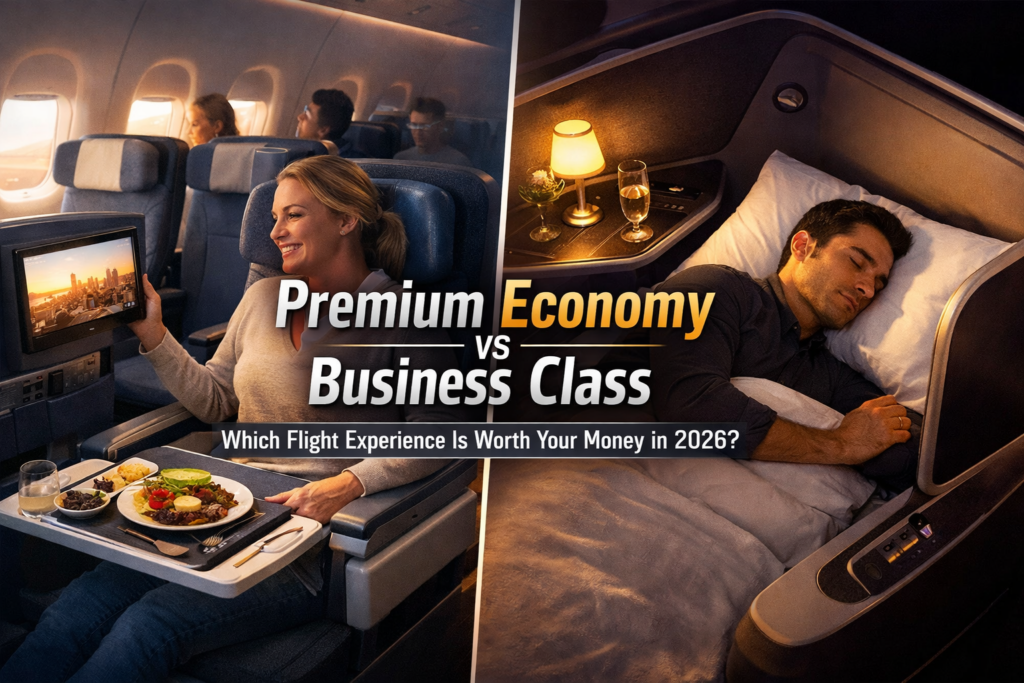
Here is the cleanest comparison. Premium economy usually gives you a wider recliner seat, more legroom, upgraded meals, some priority services, and better baggage treatment. Business class typically adds a fully flat bed, more privacy, direct aisle access on many modern long-haul aircraft, stronger dining, lounge access, and a much more premium airport flow. Air France’s business design language alone tells the story: flat bed, aisle access, privacy. Virgin Atlantic and Delta repeat the same message in their own way. So the major dividing line is not food or service. It is whether your body gets to lie flat and whether your travel day gets buffered from the airport’s chaos. If you are comparing value, start there, because seat geometry and sleep quality influence everything else.
| Feature | Premium Economy | Business Class |
|---|---|---|
| Seat type | Wider recliner with extra pitch and leg/foot rests on many airlines | Fully flat or near-flat bed on long-haul premium products |
| Airport benefits | Often priority check-in/boarding/baggage | Priority services plus lounge access on many carriers |
| Dining | Upgraded meals, drinks, sometimes Champagne | Multi-course dining, premium beverages, more personalized service |
| Privacy | Better than economy, still limited | Significantly higher, often with direct aisle access and doors/screens |
| Best use case | Leisure value, daytime flights, self-funded trips | Overnight long-haul, work trips, tight schedules, jet-lag control |
The money question becomes sharper when you look at route type. On a six- to eight-hour daytime flight, premium economy can be the sweet spot because you are awake, eating, watching movies, and landing the same day. In that scenario, the flatter seat matters less, while the extra room matters a lot. On a red-eye or ultra-long-haul flight, the equation flips. A bed in the sky is not just a luxury item; it is a recovery tool.
When Premium Economy Is the Better Buy
Premium economy is the better buy for the majority of self-funded leisure travelers. That may sound surprising in an article comparing it to business class, but value is not the same thing as prestige. If you are flying long-haul for vacation, paying with your own money, and you care about comfort without detonating your budget, premium economy often lands in the smart middle. You get more legroom, a quieter cabin, improved meals, better service touches, and priority handling that smooths the day without charging you for every inch of luxury branding. Skyscanner’s 2026 spending data suggests travelers still want better experiences, but they are becoming more selective with extras. Premium economy fits that mood almost perfectly. It lets you feel upgraded without paying for benefits you may not fully use, like lounge time on a short connection or a lie-flat bed on a daytime route.
It also works especially well for families, couples, and travelers who prefer to put more money into the destination instead of the seat. Think about it this way: if the flight is the hallway to the trip, not the event itself, premium economy is often enough. The wider seat, deeper recline, better meal, and baggage priority improve the hallway without turning it into a luxury apartment you only occupy for one night. Premium economy can also be the smartest move for travelers using points strategically, because the price jump from economy is sometimes far easier to justify than the leap to business. The product is no longer a half-step. On strong carriers, it is a meaningful category of its own. It just should not be confused with business class, because one helps you arrive a little better, while the other can help you arrive genuinely restored.
When Business Class Is Worth the Premium
Business class is worth the premium when your arrival condition matters almost as much as the arrival itself. Overnight flights are the obvious example. So are long connections, high-stakes presentations, weddings, important family events, or any trip where you need to hit the ground functioning at a high level. A lie-flat bed, airport lounge, faster service touchpoints, and extra privacy can preserve several hours of real recovery. That is why companies still pay for premium travel in certain circumstances, even when budgets tighten. Deloitte notes that frequent corporate travelers are more likely to book premium options, and airlines continue dedicating more of the aircraft to premium seating because demand for higher-value products has mattered so much in recent years. Business class is not simply selling status; it is selling performance, time efficiency, and biological damage control.
There is also a premium threshold where paying more becomes rational because the downside of not paying is expensive in other ways. If you lose sleep, arrive foggy, spend money on airport meals, need a hotel day room to recover, or waste your first day at the destination, the “cheaper” ticket may stop being cheaper. Virgin Atlantic’s flat bed and Clubhouse access, Emirates’ lie-flat seating and lounge benefits, Delta’s dedicated premium ground experience, and Air France’s privacy-focused long-haul business design all point in the same direction: business class is engineered to reduce friction from curb to cabin to arrival. For travelers who treat time as money, or energy as a limited resource, that engineering can absolutely be worth paying for. The trick is not buying it every time. The trick is buying it on the routes where it changes outcomes.
Conclusion: The Smartest Flight Upgrade Decision for 2026
So, premium economy vs business class comes down to one brutally simple test: are you buying comfort, or are you buying recovery? Premium economy is usually the smarter value play for daytime flights, leisure trips, and self-funded travel where you want more room, better food, and smoother service without paying for a bed you may not need. Business class becomes the smarter purchase when the route is long, the timing is cruel, the meeting matters, the jet lag risk is real, or the trip is important enough that arrival quality has financial or personal value. In 2026, that distinction matters more because travelers are spending, but spending more selectively, while airlines are still pushing premium cabins as a key profit engine. The best cabin is not the fanciest one. It is the one that solves the most expensive problem on your trip.
If you want a clean final verdict, here it is. Choose premium economy when you want the best balance of price, comfort, and practicality. Choose business class when you need sleep, privacy, time savings, and a stronger next day. One is the best upgrade for most people. The other is the best upgrade for the right trip. That may not sound as glamorous as saying business class always wins, but it is the truth. And in travel, just like in investing, the smartest decision is rarely the most glamorous one. It is the one where the return matches the cost.
FAQs
1. Is premium economy worth it in 2026?
Yes, for many travelers it is. Premium economy is often worth it when you want noticeably more space, better food, and priority treatment without paying the much higher price for business class. It is especially attractive on medium- and long-haul daytime flights.
2. Is business class worth the extra money over premium economy?
Yes, but mainly when sleep, privacy, and airport efficiency are critical. The biggest difference is the flat bed and premium ground experience, which can make a major difference on red-eyes and ultra-long-haul routes.
3. Do premium economy tickets include lounge access?
Usually not as a standard benefit on many airlines, although policies vary by carrier, fare, route, and elite status. By contrast, business class pages from airlines like Virgin Atlantic, Emirates, and Delta explicitly promote lounge access or premium ground privileges.
4. Which is better for overnight flights: premium economy or business class?
Business class is usually the better choice for overnight flights because the lie-flat seat can protect sleep and help you function better after arrival. Premium economy improves comfort, but it normally cannot match the recovery benefit of a bed.
5. Which cabin offers the best value for leisure travelers?
Premium economy often offers the best value for leisure travelers paying cash, especially when the destination matters more than turning the flight into a luxury experience. It delivers a meaningful improvement over economy while keeping far more budget available for hotels, food, and activities.