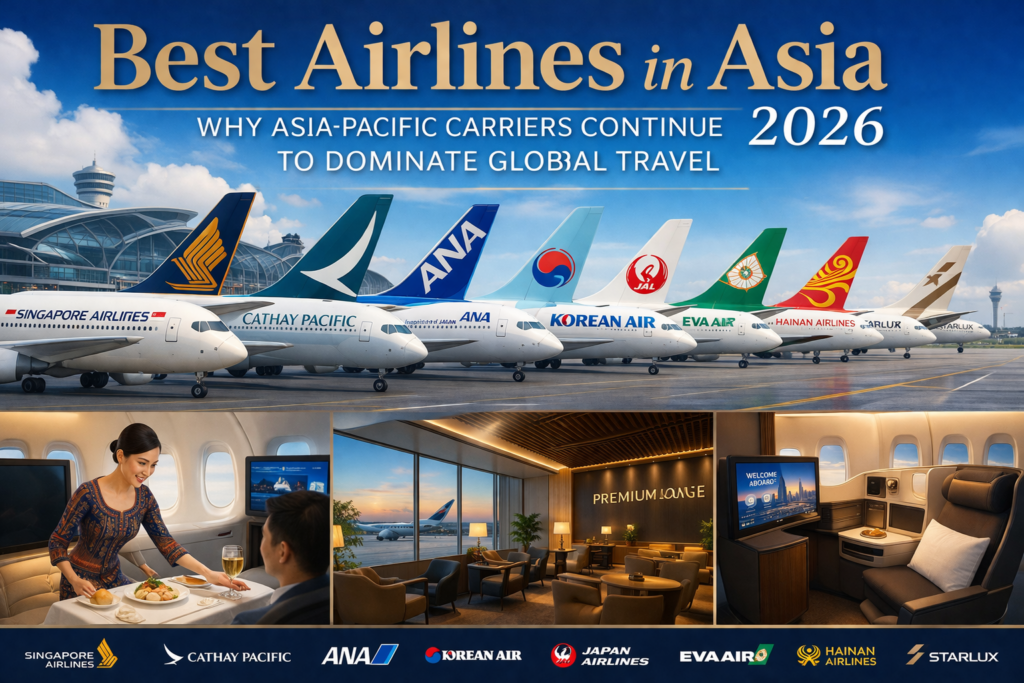
Asia’s top airlines are not leading the global travel conversation by accident. They are doing it through disciplined operations, exceptional service culture, premium cabin innovation, powerful hub strategies, and an almost relentless focus on consistency. When travelers search for the best airlines in Asia 2026, they are usually looking for more than a ranking. They want to know which carriers offer the most dependable international flights, the strongest premium travel experience, the best business class, the smoothest airport services, and the highest level of passenger satisfaction.
In 2026, the answer remains strikingly clear: Asia-Pacific airlines continue to dominate many of the quality signals that shape global airline reputation. Skytrax’s 2025 regional results named Singapore Airlines the Best Airline in Asia, followed by Cathay Pacific, ANA All Nippon Airways, Korean Air, Japan Airlines, Hainan Airlines, and EVA Air. At the same time, Asia-based carriers filled much of the upper tier in the global Top 100, with Singapore Airlines ranked second, Cathay Pacific third, ANA fifth, Korean Air seventh, Japan Airlines ninth, Hainan tenth, and EVA Air twelfth.
That dominance is happening while the region itself is growing faster than many others. IATA reported in January 2026 that Asia-Pacific international premium demand rose 7.3% year over year in 2025, and its March 2026 quarterly chartbook said Asia-Pacific became the largest contributor to worldwide traffic in 2025, with passenger demand up 7.4% YoY in Q4 2025 and international corridor traffic for Asia-Pacific airlines up 9.3% YoY. ICAO has also highlighted the region as the long-term engine of global air traffic growth, noting in July 2025 that Asia-Pacific traffic is expected to lead expansion toward 12.4 billion passengers by 2050. Put simply, Asia is not just home to excellent airlines. It is the center of gravity for the future of commercial aviation.
Why Asia-Pacific Airlines Remain So Competitive
The biggest reason Asia-Pacific airlines keep winning is that they treat the customer journey as a system, not a collection of disconnected services. In weaker airline models, the passenger experiences check-in, boarding, lounge access, cabin service, inflight entertainment, and arrival as separate touchpoints. In the best Asian carriers, those moments feel connected. The crew tone matches the brand. The airport process reflects the cabin quality.
The premium seat aligns with the meal design. The loyalty proposition supports the network strategy. That coherence matters because premium passengers, corporate travelers, and even economy customers notice when an airline feels thoughtfully run. Skytrax’s category awards show this clearly. In 2025, Singapore Airlines won the world’s best cabin crew, Cathay Pacific won best inflight entertainment, and ANA won world’s best airport services, with Japan Airlines and EVA Air also placing strongly in airport-services rankings. These are not random wins. They show that Asian carriers lead across multiple layers of the travel experience.
The second reason is culture. Service culture sounds soft, but in aviation it is a hard competitive advantage. Airlines that consistently win at the top end do not simply hire polite staff. They build institutions where discipline, attentiveness, precision, and hospitality reinforce one another. That is why so many Asian carriers appear again and again across cabin crew, service, and premium satisfaction awards. In 2025, the world’s best cabin crew list included Singapore Airlines, ANA, Cathay Pacific, Garuda Indonesia, EVA Air, Hainan Airlines, Japan Airlines, Malaysia Airlines, STARLUX Airlines, and Korean Air in the global top ten or close to it. That kind of regional concentration is not a coincidence. It reflects training systems and customer-facing cultures that scale remarkably well.
The Best Airlines in Asia 2026
Singapore Airlines
If you want the clearest symbol of Asia’s airline strength, start with Singapore Airlines. Skytrax named it the Best Airline in Asia 2025, and globally it ranked No. 2 in the world. It also won the World’s Best Airline Cabin Crew 2025, confirming something frequent travelers have believed for years: Singapore Airlines does not just excel at the hard product, it excels at the human side of travel too. The airline’s reputation comes from a rare balance of precision and warmth. It can feel deeply polished without becoming cold. It can feel premium without feeling theatrical. That balance matters because many luxury travelers want confidence and ease more than spectacle.
Singapore Airlines also benefits from brand architecture that supports premium trust. Its long-haul network, hub efficiency, premium cabins, and globally respected service standards make it one of the safest bets for travelers spending serious money on international tickets. In a market shaped by business class demand, premium economy upgrades, luxury flights, and corporate travel policies, that reliability turns into commercial strength. The airline has stayed at or near the top of global rankings for years because it understands that a great flight is not only about a seat or a meal. It is about how effortless the entire journey feels from the first click to final arrival.
Cathay Pacific
Cathay Pacific has reasserted itself as one of Asia’s strongest premium airline brands. Skytrax placed it third globally and second in Asia in 2025, while also awarding it the World’s Best Inflight Entertainment 2025. AirlineRatings went even further on the broader brand side, ranking Cathay Pacific No. 2 in its World’s Best Full-Service Airlines for 2026, behind only Qatar Airways and ahead of Singapore Airlines. That combination is significant because it shows Cathay is not merely respected in one award ecosystem. It is performing strongly across multiple evaluators and multiple dimensions of quality.
Cathay’s appeal is rooted in a very specific kind of premium confidence. It does not market itself with the loudest possible luxury language. Instead, it tends to succeed by delivering a polished long-haul proposition with strong cabin design, high entertainment quality, and a brand identity associated with calm, premium professionalism. For travelers connecting through Hong Kong or flying long-haul business routes, that matters enormously. Cathay’s resurgence proves that when an airline gets the fundamentals right again, the market notices quickly.
ANA All Nippon Airways
ANA remains one of the most complete airlines in Asia because it performs at a high level in exactly the places travelers often underestimate. It ranked third in Asia and fifth globally in the Skytrax 2025 results, and it won the World’s Best Airport Services 2025, with Japan Airlines second and EVA Air third in that category. ANA also ranked second globally for cabin crew in 2025. Those results tell an important story. ANA is not only admired in the air. It is admired in the airport, in ground handling, in transfers, in staff interactions, and in the friction points that often decide whether a trip feels smooth or stressful.
That strength makes ANA especially compelling in 2026 because modern travelers care deeply about seamlessness. Flight quality begins before takeoff. A great premium airline now has to manage lounge flow, boarding clarity, connection experience, transfer support, and post-arrival process with the same precision it brings to onboard service. ANA’s excellence in airport services gives it a serious edge because it turns one of aviation’s most frustrating zones into a brand advantage. In practical SEO terms, that is why ANA ranks well not just for “best airline” intent, but also for adjacent search interests like best airport experience, best service airline, and most reliable Japanese airline.
Korean Air and Japan Airlines
Korean Air and Japan Airlines sit in that powerful second cluster of Asian aviation excellence: carriers that may not dominate every headline, but remain globally trusted, premium, and highly competitive. Skytrax ranked Korean Air fourth in Asia and seventh globally, while Japan Airlines placed fifth in Asia and ninth globally. AirlineRatings’ 2026 full-service ranking put Korean Air even higher at No. 4 worldwide and Japan Airlines at No. 6. That dual recognition matters because it confirms that both carriers combine customer-facing quality with broader airline excellence.
Japan Airlines also placed second in airport services behind ANA, which reinforces Japan’s broader aviation reputation for order, service discipline, and operational reliability. Korean Air, meanwhile, benefits from a powerful long-haul network, a strong premium image, and improving global recognition. Travelers looking for best transpacific airline, best Asian business class, or most reliable long-haul carrier in Asia often land in this part of the market because these airlines consistently combine comfort with credibility. They may not always be the flashiest brands, but aviation is not won by flash alone. It is won by consistency that survives scale.
EVA Air, Hainan Airlines, and STARLUX Airlines
The depth of Asian airline quality becomes even more impressive once you move beyond the obvious names. EVA Air ranked seventh in Asia and twelfth globally in Skytrax’s 2025 results, while Hainan Airlines ranked sixth in Asia and tenth globally. On the AirlineRatings 2026 list, EVA Air placed 11th worldwide, and STARLUX Airlines reached 5th, ahead of many much larger legacy brands. Skytrax also named STARLUX the World’s Most Improved Airline 2025, with HK Express third in the same category. These rankings matter because they show Asia’s dominance is not built by one or two superstar flag carriers. It is supported by a broad bench of ambitious, high-performing airlines.
For travelers, that creates a richer competitive landscape. EVA Air is known for dependable premium service and solid ground performance. Hainan continues to hold a place among Asia’s respected full-service carriers. STARLUX represents a newer generation of premium Asian airline thinking, one built around modern branding, product ambition, and rapid quality improvement. This matters commercially because competition inside Asia is forcing the region’s airlines to innovate faster. It is one thing to compete against distant global giants. It is another to compete in the same neighborhood against Singapore Airlines, Cathay Pacific, ANA, JAL, Korean Air, EVA, and a fast-rising premium challenger like STARLUX. That level of internal competition keeps standards high.
Why Asia-Pacific Carriers Dominate Global Travel
One major reason is demand. IATA’s 2026 data shows Asia-Pacific is not just recovering; it is driving the market. Its quarterly chartbook said the region was the largest contributor to worldwide traffic in 2025, with Q4 passenger demand growth at 7.4%, ahead of the global growth rate of 6.0%, and capacity growing more slowly at 6.5%, pushing load factor to 84.7%, slightly above the industry average. That is not merely a traffic story. It is a profitability and strategic power story. Airlines operating in fast-growing, high-density international corridors gain more opportunities to refine products, build loyalty, and spread premium innovations across large networks.
Another reason is infrastructure and hub logic. The strongest Asian airlines tend to be anchored by efficient, globally connected hubs that help the whole brand perform better. A premium cabin feels more premium when transfers work, lounges are strong, boarding is controlled, and airport staff are aligned with the airline’s service culture. Skytrax’s airport-services results show how much this matters, with ANA, JAL, and EVA excelling in customer satisfaction around ticketing, check-in, lounge service, boarding, transfer, and arrivals. In other words, Asian carriers often dominate global travel because they do not treat the airport as a necessary inconvenience. They treat it as part of the product.
The third reason is product range. Asia does not dominate only in full-service premium travel. It also leads in budget and hybrid segments. Skytrax named AirAsia the World’s Best Low-Cost Airline 2025 for the 16th consecutive year, with Scoot named the World’s Best Long Haul Low-Cost Airline, and IndiGo ranked third in the global low-cost list. That breadth matters. It means Asia is shaping global travel at both ends of the market: aspirational premium and efficient value. A region that can lead in both first-class prestige and low-cost scale is a region setting the pace for the entire industry.
Comparison Table: Best Airlines in Asia 2026
| Airline | Key 2025–2026 proof point | Why travelers trust it |
|---|---|---|
| Singapore Airlines | Best Airline in Asia 2025; No. 2 globally; Best Cabin Crew 2025 | Elite premium consistency, strong service culture, global trust |
| Cathay Pacific | No. 2 in Asia 2025; No. 3 globally; Best Inflight Entertainment 2025; No. 2 in AirlineRatings 2026 | Strong premium recovery, polished long-haul experience, entertainment leadership |
| ANA | No. 3 in Asia 2025; No. 5 globally; Best Airport Services 2025 | Outstanding ground experience, disciplined service, strong Japanese reliability |
| Korean Air | No. 4 in Asia 2025; No. 7 globally; No. 4 in AirlineRatings 2026 | Strong long-haul credibility and rising global recognition |
| Japan Airlines | No. 5 in Asia 2025; No. 9 globally; No. 2 for Airport Services 2025 | Excellent ground handling and strong premium trust |
| EVA Air | No. 7 in Asia 2025; No. 12 globally; No. 3 for Airport Services 2025 | Dependable service and strong customer confidence |
| STARLUX Airlines | No. 5 in AirlineRatings 2026; Most Improved Airline 2025 | Fast-rising premium brand with strong momentum |
What This Means for Travelers in 2026
For travelers, Asia’s airline dominance means choice without sacrificing quality. You can fly with a classic legacy premium brand like Singapore Airlines, ANA, or JAL; a resurgent long-haul specialist like Cathay Pacific; a fast-improving premium challenger like STARLUX; or a value-driven leader like AirAsia or Scoot. That depth is rare. In many regions, airline excellence is concentrated in one or two names. In Asia-Pacific, it is distributed across multiple countries, business models, and service styles. That competition benefits passengers directly through better cabins, stronger service, smarter airport handling, and more pressure on carriers to stay sharp.
It also means Asia will likely remain the most influential region in airline product development. As traffic grows, hubs expand, and premium demand continues to recover, airlines based in the region will keep shaping expectations around business class design, airport services, cabin crew standards, inflight entertainment, and long-haul travel comfort. The rest of the world is still competing, of course. But when the conversation turns to service leadership, brand discipline, and passenger trust, Asia-Pacific carriers continue to set the benchmark that others chase.
Conclusion
The best airlines in Asia in 2026 are leading global travel because they combine the things that matter most: strong service culture, premium product quality, airport efficiency, network strength, and a level of consistency that travelers genuinely trust. Singapore Airlines, Cathay Pacific, ANA, Korean Air, Japan Airlines, EVA Air, Hainan Airlines, and STARLUX all help explain why the region remains so dominant. This is not a temporary spike. It reflects a mature competitive ecosystem supported by growing demand, world-class hubs, and airlines that keep improving instead of coasting on reputation.
The broader industry data makes that story even stronger. Asia-Pacific was the largest contributor to global traffic in 2025, international premium demand in the region continued to rise, and ICAO sees the region leading long-term traffic growth. When you combine those market realities with the fact that Asian carriers own so many of the most important quality awards, one conclusion becomes hard to avoid: Asia-Pacific airlines are not just participating in global travel leadership—they are defining it.
FAQs
1. Which airline is the best in Asia in 2026?
Based on the latest major regional award results available, Singapore Airlines is the Best Airline in Asia, according to Skytrax’s 2025 regional rankings.
2. Which Asian airline ranks highest globally?
Among Asia-based airlines in the latest Skytrax global ranking, Singapore Airlines is highest at No. 2, followed by Cathay Pacific at No. 3 and ANA at No. 5.
3. Which Asian airline has the best cabin crew?
Singapore Airlines won the World’s Best Airline Cabin Crew 2025 award, with ANA second and Cathay Pacific third.
4. Which Asian airline offers the best airport services?
ANA won the World’s Best Airport Services 2025 award, with Japan Airlines second and EVA Air third.
5. Which low-cost airlines lead in Asia?
AirAsia was named the World’s Best Low-Cost Airline 2025, while Scoot won World’s Best Long Haul Low-Cost Airline and IndiGo ranked third among low-cost carriers globally.