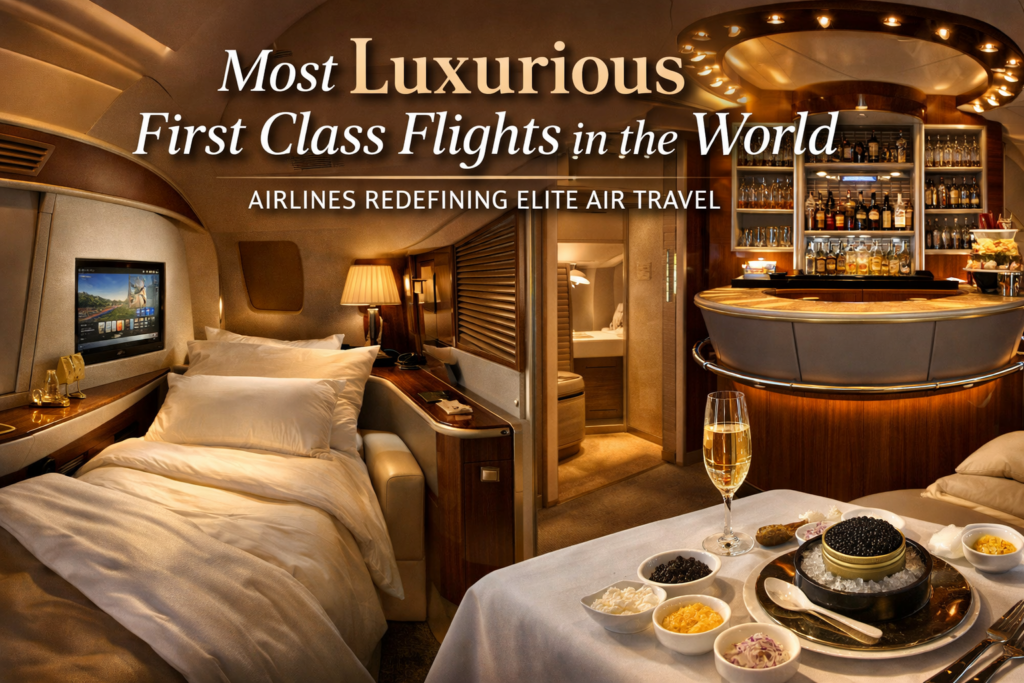
Why First Class Luxury Still Matters in 2026
Most Luxurious First Class Flights in the World, there is a lazy argument that business class has become so good that first class flights no longer matter. On paper, that sounds sensible. In reality, the top end of the market keeps proving otherwise. Luxury aviation is not just selling transport; it is selling control, privacy, and frictionless time. A truly elite cabin removes the small irritations that wear travelers down: waiting, noise, compromise, cramped storage, fixed dining times, weak bedding, rushed airport processes, and the feeling that service is being delivered at scale rather than tailored around you. That is why the best airlines still invest in flagship first class even as many others trim it. Skytrax’s 2025 awards show that carriers continue to compete intensely in first class, with Singapore Airlines, Emirates, and Air France leading the global rankings, while specialist categories for lounge dining, seats, comfort amenities, and onboard catering remain major battlegrounds.
The bigger story is that luxury travel has become an end-to-end product. The seat alone is no longer enough. Today’s premium passenger expects chauffeur service, priority check-in, private lounge access, custom dining, exclusive amenities, faster transit through the airport, and a cabin that feels like a personal sanctuary rather than a polished version of premium mass travel. In that environment, the airlines winning at the top end are the ones treating the whole journey like a carefully staged performance. Air France explicitly presents La Première as “the highest expression of travel,” while Emirates continues to refine its first class product with new service rituals, upgraded check-in spaces, unlimited caviar presentation, and one of the broadest global first class footprints in the industry.
What Actually Makes a First Class Flight Luxurious
A luxurious first class cabin is built on five pillars: space, privacy, sleep quality, dining excellence, and service orchestration. Space sounds obvious, but the best airlines define it differently. Some focus on enclosed suites with floor-to-ceiling doors. Others create modular living areas with separate seating and sleeping surfaces. Some go even further and turn the flight into a genuine residential concept with multiple rooms. Privacy matters because premium travelers are not just buying a better seat; they are buying separation from the shared logic of commercial flying. That is why doors, partitions, wardrobes, large screens, personal temperature settings, and quiet, low-density cabins keep showing up in every serious first class product worth discussing. Emirates highlights fully enclosed suites, mood lighting, temperature controls, and even virtual windows on selected Boeing 777 aircraft, while ANA’s The Suite centers its offer on doors, a 43-inch 4K monitor, and a highly self-contained private environment.
The second layer is less visible but even more important: how the experience flows. Luxury is not just having caviar or designer pajamas. Luxury is when the passenger never has to think too hard. Dining should happen when you want, not when the cart arrives. Bedding should feel restorative, not symbolic. Storage should be intuitive. Service should anticipate rather than react. That is why the top products are increasingly defined by small details that compound into a feeling of total ease. Singapore Airlines pairs its Suites with a personal dining table, Wedgwood tableware, and Book the Cook meal selection, while Emirates emphasizes dine-on-demand service, premium drinks, shower spa access on the A380, and a lounge bar that turns the upper deck into a social venue. These are not random perks. They are carefully chosen signals that the airline understands luxury as an emotional state, not just a list of amenities.
The Airlines Leading Elite Air Travel Right Now
Singapore Airlines Suites
When travelers talk about the best first class in the world, Singapore Airlines almost always enters the conversation early, and with good reason. Skytrax ranked it the World’s Best First Class Airline in 2025, and also placed it first for first class seats, first class onboard catering, and best first class airline in Asia. That consistency matters. It suggests Singapore Airlines is not winning on one flashy feature but on the total composition of the experience. The A380 Suites product remains one of the most recognizable luxury concepts in commercial aviation because it combines scale, elegance, and an unusually residential feel. The official product highlights full-grain leather seating by Poltrona Frau, hand-tufted carpets, an ensuite wardrobe, a personal dining table, and premium meal service with Wedgwood china and the Book the Cook option.
What makes Singapore Airlines particularly impressive is its restraint. Some airlines chase luxury by adding theatrical details. Singapore Airlines wins by making everything feel composed, premium, and calm. The Suites cabin does not shout. It whispers with confidence. That matters for affluent travelers who often associate true luxury with refinement rather than spectacle. The product is also strong for couples, because the Suites concept on the A380 has long been associated with a more spacious and intimate onboard environment than many rival cabins. When you combine award-winning catering, privacy, polished service culture, and one of the most recognized premium brands in aviation, Singapore Airlines becomes less a flashy indulgence and more a benchmark for how elite air travel should feel when every detail is edited properly.
Emirates First Class
If Singapore Airlines represents understated mastery, Emirates First Class represents the full spectacle of modern luxury aviation. Emirates has built one of the most commercially visible first class brands in the world, and its official positioning makes that clear. The airline describes its A380 first class as having privacy doors, fine dining at any time, an onboard shower spa, and access to the upper deck lounge bar. On the Boeing 777, Emirates pushes a different kind of luxury: a fully enclosed suite with mood lighting, temperature controls, and virtual windows on certain middle suites. The contrast is part of the appeal. Emirates can sell both the social glamour of the A380 and the cocooned privacy of the 777.
The airline has also kept evolving the product rather than simply living off old marketing glory. In May 2025, Emirates said it offered 26,800 first class seats a week and described itself as the world’s largest operator of international first class travel. The same update detailed refreshed check-in design, unlimited caviar, gloved cabin service, Byredo skincare, Bulgari amenity kits, premium wine holdings, shower spas on the A380, and access to 43 luxury lounges globally plus chauffeur service across most destinations. That breadth is difficult for competitors to match. Emirates is not merely selling a premium seat; it is selling a global luxury network. For travelers who equate luxury with abundance, ritual, and polished excess, Emirates remains one of the strongest answers on the market.
Air France La Première
Air France La Première has become one of the most fascinating luxury plays in aviation because it leans hard into a distinctly French interpretation of prestige. Rather than chasing gimmicks, it emphasizes design language, privacy, elegance, and an airport-to-aircraft journey that feels curated. In 2025, Air France unveiled its new La Première suite after three years of development, describing it as a modular design with a seat and chaise longue that transform into a full bed. The airline also states that the cabin offers one of the longest first class configurations on the market and positions La Première as the highest expression of travel. Skytrax ranked Air France third in the world for first class in 2025, first in Europe, and first for first class comfort amenities, while also placing its Paris Charles de Gaulle lounge highly across lounge categories.
What makes La Première special is the way it turns luxury into mood. This is not the first class product for someone who wants to brag about showering on a plane. It is for someone who notices textures, transitions, pacing, and atmosphere. Air France explicitly says every stage of the journey is designed to deliver an exceptional, tailor-made experience, and that framing is important. The airline is not treating first class like a bigger business class seat. It is treating it like haute hospitality. That makes La Première especially compelling for travelers who care as much about aesthetic experience and service choreography as they do about hard product specifications. In a market where many premium cabins are starting to resemble each other, Air France feels refreshingly distinct.
Etihad The Residence and First
There is luxury, and then there is Etihad The Residence. Even in today’s premium aviation landscape, a multi-room suite in the sky still sounds almost surreal. Etihad describes The Residence on the A380 as a space for up to two guests with a private bedroom, separate living area, and ensuite shower room. That alone places it in a category beyond conventional first class. It feels less like a premium airline seat and more like a micro private jet suite inside a scheduled commercial flight. Even Etihad’s broader first class positioning leans into concierge-style personalization, with dedicated planning support and premium designer amenities for first and Residence guests.
Still, The Residence is not the right benchmark for every traveler because it is so rare and so specialized. It works best as the ultimate statement product, the one that stretches the commercial airline model furthest toward bespoke residential travel. That rarity is part of the mystique. Skytrax ranked Etihad fifth for first class seats and twelfth overall in first class for 2025, which reflects the fact that the brand still commands prestige at the high end even without the same network scale as Emirates or the same award dominance as Singapore Airlines. For travelers who want the most extreme version of ultra-luxury flights, Etihad remains impossible to ignore. It is the aviation equivalent of a penthouse suite: not always the default choice, but unforgettable when it aligns with the trip.
ANA The Suite
ANA approaches first class with a Japanese design philosophy that values clarity, comfort, and function. Its The Suite product on the Boeing 777-300ER gives travelers privacy doors, a fully flat seat, and a 43-inch 4K monitor. On paper, that may sound less dramatic than onboard showers or three-room apartments. In practice, it appeals to a different luxury instinct: the idea that premium service should feel intentional, precise, and deeply usable. The cabin does not seem built to impress from a distance. It seems built to satisfy once you live in it for a long-haul sector. Skytrax ranked ANA sixth in global first class and also placed it inside the top tier for first class seats, comfort amenities, and lounge performance.
That makes ANA one of the smartest choices for travelers who care about serene design and practical comfort over theatrical branding. The Suite gives you the things that actually shape a long flight: personal enclosure, space to work or relax, large-screen entertainment, and an environment that feels modern without trying too hard. In luxury markets, subtlety is underrated. ANA proves that first class does not need visual drama to feel expensive. It needs coherence. When the seat, the privacy, the service culture, and the cabin mood all line up, the result can feel more luxurious than a product with louder headline features. That is why ANA consistently remains in serious discussions about the best premium airline experience in the world.
Qatar Airways First Class
Qatar Airways is more famous globally for business class, yet its A380 First Class still deserves a place in any serious luxury ranking. Skytrax ranked Qatar Airways ninth in first class in 2025, fifth for first class lounge dining, and inside the global top ten for comfort amenities and seats. The airline’s first class product focuses on spacious seating, full privacy, a fully lie-flat bed, and access to one of the largest onboard lounges in the industry on the A380. Qatar’s Singapore-specific A380 page also confirms that from 12 January 2026 the airline is operating A380 service between Singapore and Doha, with 8 first class seats on the aircraft.
What makes Qatar interesting is the way it layers a strong first class product inside an airline brand already associated with premium excellence. Skytrax named Qatar the World’s Best Airline 2025, which reinforces the trust many high-end travelers already place in its service standards. Qatar’s first class may not dominate headlines as aggressively as Emirates or Singapore Airlines, but it fits travelers who want polished luxury delivered by a carrier with global prestige, a powerful hub, and a highly competitive airport-lounge ecosystem. Think of it as quiet confidence with excellent fundamentals. In the luxury market, that combination is often more durable than marketing fireworks.
Comparing the Best First Class Products
Here is a practical comparison of the leading luxury first class airlines based on current official product details and 2025 award performance.
| Airline | Signature luxury differentiator | Best for | Current proof points |
|---|---|---|---|
| Singapore Airlines Suites | A380 Suites with highly refined residential feel, premium dining, Book the Cook, personal dining table | Travelers wanting balanced excellence across seat, catering, and elegance | Ranked No. 1 First Class Airline 2025 by Skytrax; also No. 1 for first class seats and catering |
| Emirates First Class | A380 shower spa, onboard lounge, dine on demand, fully enclosed 777 suites | Travelers wanting spectacle, global reach, and premium abundance | Emirates says it offers 26,800 first class seats weekly; upgraded service and amenities detailed in 2025 update |
| Air France La Première | New modular suite with seat, chaise longue, and full bed; deeply curated ground experience | Travelers wanting design-led European luxury | Ranked No. 3 globally and No. 1 in Europe for first class in 2025 |
| Etihad The Residence / First | Multi-room suite with living area, bedroom, and ensuite shower | Travelers seeking the most exclusive statement experience | Official Residence page confirms three distinct living spaces; Skytrax places Etihad among top first class seat products |
| ANA The Suite | Privacy doors and 43-inch 4K monitor in a calm, highly functional design | Travelers valuing understated luxury and usability | ANA officially highlights privacy door and 43-inch 4K screen; Skytrax ranks ANA sixth in first class 2025 |
| Qatar Airways First Class | Spacious A380 first class with lie-flat bed and access to a major onboard lounge | Travelers wanting polished premium comfort on select routes | Qatar confirms A380 first class and 8-seat layout on Singapore-Doha service from Jan. 12, 2026 |
How Airlines Are Redefining the High-End Passenger Journey
The most important shift in elite air travel is that luxury now begins before boarding. That sounds obvious, but it changes how airlines build premium products. A first class ticket now competes not only with rival airlines, but also with private aviation expectations. That is why ground handling, lounge architecture, security fast tracks, private transfers, and personalized contact matter so much. Emirates is refurbishing its first class check-in area in Dubai into a lounge-like space while continuing chauffeur service and broad lounge access. Air France talks about every stage of La Première as part of an exceptional tailor-made journey. Qatar’s premium reputation is reinforced by a hub-and-lounge ecosystem that already has strong recognition. The message across the industry is clear: the seat is only one chapter. The brand must own the whole rhythm of the trip.
Personalization is the other major frontier. The future of luxury flights is not simply bigger cabins. It is smarter service. Pre-selected dining, digital menus, bespoke amenity partnerships, concierge support, dine-on-demand, and aircraft-specific suite identities all point in the same direction. Airlines are trying to make premium travelers feel that the experience bends around them instead of forcing them into a rigid operating system. That is a big reason first class remains relevant despite the rise of excellent business class cabins. Business class has become extraordinarily competent. First class, at its best, still feels personal. And in luxury markets, personal beats premium almost every time.
Conclusion
The world’s most luxurious first class airlines are no longer competing on simple comfort. They are competing on atmosphere, privacy, service design, and emotional impact. Singapore Airlines Suites leads when you want total balance and award-backed consistency. Emirates First Class dominates for theatrical luxury, global scale, and iconic features like the shower spa and onboard lounge. Air France La Première is the choice for travelers drawn to sophisticated design and a deeply curated end-to-end journey. Etihad The Residence stands apart as the boldest expression of residential air travel, while ANA The Suite proves that calm precision can feel just as expensive as spectacle. Qatar Airways First Class, though more selective in availability, remains a serious premium option for travelers who value strong fundamentals within a globally admired airline brand.
The real story is bigger than any single airline. Premium demand is still strong, and the best carriers are turning first class into a luxury ecosystem that starts at booking and ends after arrival. That is why the category still matters. When done properly, luxury first class travel is not a nicer seat. It is a different way of moving through the world.
FAQs
1. Is first class really better than business class on top airlines?
Yes, but the difference depends on the airline. The top first class products separate themselves with much greater privacy, lower cabin density, more personalized dining, better ground services, and more exclusive lounges. On airlines like Singapore Airlines, Emirates, Air France, and Etihad, the leap from business class to first class is still meaningful because the product is built as a flagship luxury experience rather than just a premium seat upgrade.
2. Which airline has the most private first class suite?
For conventional first class, Emirates and ANA stand out because both emphasize enclosed privacy, while Emirates also offers fully enclosed suites with virtual windows on selected 777 aircraft. For sheer exclusivity, Etihad The Residence goes further than a standard suite by offering separate living and sleeping spaces plus an ensuite shower room.
3. Which first class product is best for couples?
Singapore Airlines Suites and Etihad The Residence are especially appealing for couples. Singapore Airlines is famous for a spacious, highly refined Suites concept on the A380, while Etihad The Residence is explicitly built for up to two guests with a bedroom, lounge area, and ensuite shower room.
4. Are luxury first class tickets worth the money?
They can be worth it for travelers who value privacy, rest, prestige, and seamless service more than pure transport efficiency. The calculation is rarely just about getting from one city to another. It is about saving energy, improving sleep, reducing stress, and turning a long-haul journey into a premium experience that feels controlled and restorative.
5. What should travelers check before booking a luxury first class flight?
Always check the aircraft type, because the same airline can offer very different first class products depending on the plane. Also confirm whether the route includes the flagship suite, lounge access, chauffeur or transfer benefits, and any special pre-order dining. Qatar’s current A380 first class, for example, is route-specific, and Singapore Airlines notes that Suites are exclusive to the A380 and may not be available if the aircraft changes operationally.