Introduction
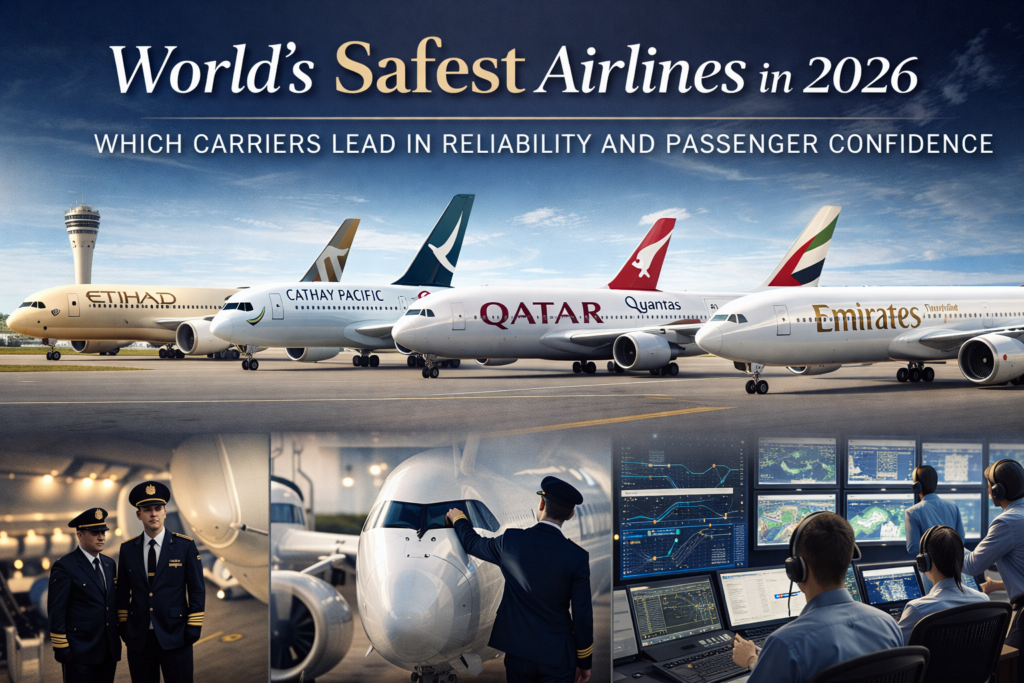
World’s Safest Airlines in 2026, airline safety is one of those topics that passengers care about deeply, even when they do not always know how to measure it. Most people look for simple reassurance. They want to know which airlines have strong safety records, modern fleets, disciplined operations, skilled pilots, and the kind of institutional culture that treats safety as non-negotiable. In 2026, that conversation is even more relevant because travelers are flying in large numbers again, premium and long-haul traffic remain strong, and public attention around operational reliability is higher than ever. The good news is that commercial aviation is still extraordinarily safe by historical standards, but the best airlines separate themselves by combining safety performance, operational consistency, fleet quality, and passenger trust into one visible brand promise. According to IATA’s 2025 Safety Report, the global all-accident rate improved to 1.32 accidents per million flights in 2025 from 1.42 in 2024, even though fatality risk rose because a small number of severe accidents accounted for most loss of life. IATA also reported that airlines on the IOSA registry had a materially lower all-accident rate than non-IOSA carriers, reinforcing the importance of structured operational safety auditing.
Why Airline Safety Rankings Still Matter in 2026
A safety ranking should never be read like a sports table where number one is “safe” and number ten is somehow questionable. That is not how aviation works. AirlineRatings itself stresses that claims one top-ranked airline is dramatically safer than another are misleading. What rankings do well is highlight carriers that consistently perform across multiple safety indicators. In 2026, the strongest airlines are the ones blending young fleets, low incident rates, strong audit performance, turbulence-prevention practices, and serious investment in pilot training. AirlineRatings said its 2026 methodology continued to weigh incident rates adjusted for number of flights, fleet age, serious incidents, pilot training, and international safety audits, while giving greater importance this year to turbulence prevention and airline transparency.
That emphasis is timely because passengers increasingly associate safety with how well an airline handles the risks they can actually imagine. Turbulence has become one of the most visible examples. Severe turbulence incidents create strong headlines, even when they do not reflect a systemic failure in airline safety. By highlighting participation in IATA Turbulence Aware or equivalent practices, the 2026 ranking acknowledges that safety leadership today is partly about prevention intelligence, not just accident history. That shift is important for SEO terms like airline safety ranking, reliable airlines, and passenger confidence, because it connects technical risk management to what travelers actually feel during a journey. A safe airline in 2026 is not just one with a clean past. It is one that shows operational maturity in the present.
The Airlines Leading Safety and Reliability in 2026
Etihad Airways
Etihad took the top spot in AirlineRatings’ 2026 full-service safety ranking, and the explanation is revealing. According to the ranking, Etihad achieved this position through a young fleet, advancements in cockpit safety, particularly around turbulence, a crash-free history, and the lowest incident rate per flight of any airline on the list. It also participated in AirlineRatings’ independent onboard safety audit and showed strong adherence to turbulence management in the cabin. That combination helps explain why Etihad stands out in conversations about premium aviation safety and trusted international airlines.
What makes Etihad especially interesting is that its safety reputation supports a broader brand narrative built around precision and premium service. In air travel, that relationship matters. Passengers often experience safety indirectly through calm boarding, disciplined cabin procedures, professional crews, and smooth communication during disruptions. Those operational signals build confidence long before anyone thinks about accident statistics. Etihad’s rise to the top also marks a milestone for Gulf aviation, because AirlineRatings explicitly noted that this is the first year a Gulf carrier has taken the number one position in its full-service safety list. That is not just a branding win for Etihad. It reflects how safety leadership has become more globally distributed across regions with modern fleets and aggressive operational investment.
Cathay Pacific and Qantas
Cathay Pacific ranked second and Qantas third in the 2026 list, and both names carry serious weight in the global airline safety conversation. Benefits from a reputation for disciplined operations, long-haul expertise, and a premium service model that tends to reinforce passenger trust. Qantas, meanwhile, remains one of the most recognizable names in aviation safety history. Even when it is not ranked number one, it remains deeply associated with robust safety culture, fleet modernization, and operational rigor. AirlineRatings placing both carriers in the top three signals that legacy excellence still matters in an industry increasingly crowded with strong competitors.
Cathay also has momentum on the broader quality side of the business. Skytrax ranked Cathay Pacific third in the World’s Top 100 Airlines 2025, behind only Qatar Airways and Singapore Airlines. That matters because passenger confidence is not built on one variable. Travelers tend to trust airlines that also demonstrate excellence in crew professionalism, cabin experience, punctuality discipline, and network execution. Qantas, for its part, ranked 14th in Skytrax’s 2025 overall airline list, showing that it remains a globally respected brand beyond just safety narratives. In other words, these airlines are not only safe by ranking criteria; they are also widely perceived as competent, premium, and reliable operators.
Qatar Airways and Emirates
Qatar Airways ranked fourth and Emirates fifth in AirlineRatings’ 2026 safety list, reinforcing the remarkable depth of Middle Eastern aviation in the current era. These carriers are often discussed first for luxury, premium cabins, and long-haul connectivity, but their safety standing is just as important. Qatar Airways was also ranked number one in Skytrax’s World’s Top 100 Airlines 2025, while Emirates ranked fourth. That suggests both brands pair strong safety credibility with high passenger satisfaction and powerful global trust.
The connection between safety and passenger confidence becomes very clear with airlines like Qatar and Emirates. Both run large international networks with high operational complexity, which means consistency is not easy. Yet they continue to perform at a level that keeps them near the top of both quality and safety conversations. For SEO-rich travel content, this matters because passengers searching best airlines 2026, safe international airlines, or most reliable long-haul airlines often overlap in intent. They are not just hunting raw safety data; they want carriers that inspire trust from booking to landing. Qatar and Emirates benefit from exactly that kind of brand halo.
Air New Zealand, Singapore Airlines, and EVA Air
Air New Zealand came in sixth, Singapore Airlines seventh, and EVA Air eighth. That cluster is fascinating because all three airlines are associated with strong service standards and disciplined operational cultures. Singapore Airlines’ return to the 2026 list is especially notable. AirlineRatings explained that the carrier had been excluded in 2025 after a serious turbulence-related incident, but was reinstated after the publication visited its safety and training center and held extensive discussions with the operations team. That level of scrutiny adds nuance. It shows the ranking is not static reputation management; it responds to current safety evaluation and direct review.
Singapore Airlines also remains one of the world’s strongest premium brands overall, ranking second in Skytrax’s 2025 top airlines list. EVA Air ranked 12th in that same ranking, again showing how quality and safety perceptions often move together. Air New Zealand did not place as high in Skytrax’s overall list, but it remains a constant presence in safety discussions because of its historically strong operational reputation and careful fleet management. For travelers, this trio represents a powerful blend of service reliability, crew professionalism, and modern airline safety standards.
What Actually Defines a Safe Airline Today
The public often reduces airline safety to accident history, but that only tells part of the story. Modern airline safety is a layered system. It includes training quality, maintenance standards, safety management systems, country-level regulatory oversight, incident response, fleet age, and increasingly, data-driven prevention tools. IATA’s IOSA program is a good example of how the industry tries to standardize that complexity. IATA describes IOSA as an internationally recognized evaluation system designed to assess the operational management and control systems of an airline. It also notes that in 2024 the program moved to a risk-based model, tailoring audit scope to each airline and introducing maturity assessment for safety-critical systems and programs.
That matters because a safe airline is not simply one that passes a checklist once. It is one that demonstrates mature systems under changing conditions. IATA’s 2025 Safety Report adds another practical layer. Airlines on the IOSA registry recorded an all-accident rate of 0.98, significantly lower than the 2.55 rate for non-IOSA carriers. IATA member airlines had an even lower rate of 0.72 per million flights, compared with 3.09 for non-members. Those figures are not a guarantee for any individual flight, but they are powerful evidence that strong audit systems and industry standards correlate with better safety outcomes. For advertisers and readers alike, that is one of the most valuable insights in the airline safety space: institutional quality matters.
Regional Performance and What It Means for Travelers
Safety is also shaped by regional operating conditions, infrastructure quality, regulatory enforcement, and fleet mix. IATA’s 2025 regional data shows significant variation. Asia-Pacific improved its all-accident rate from 1.08 to 0.91 per million sectors, beating its five-year average of 0.99. Middle East and North Africa improved from 1.09 to 0.53, with fatality risk remaining zero since 2019. Europe improved from 1.48 to 1.30, though still above its five-year average of 1.11. North America, by contrast, saw its all-accident rate rise to 1.68 in 2025 from 1.49 in 2024. These figures do not mean passengers should fear one region and trust another blindly, but they do show how infrastructure, fleet composition, and operational context influence the big picture.
For travelers, the practical takeaway is simple. If you are choosing among major full-service global airlines, you are usually selecting within a very safe part of the market. The smarter question is not, “Is this airline safe at all?” but “Which airline combines proven safety systems with the highest operational confidence?” That is where rankings, audits, and brand-level reliability become useful. Airlines like Etihad, Cathay Pacific, Qantas, Qatar Airways, Emirates, Singapore Airlines, and EVA Air score well because they consistently signal control, maturity, and high standards across the journey.
Comparison Table: Safest Full-Service Airlines in 2026
| Rank | Airline | Why it stands out in 2026 |
|---|---|---|
| 1 | Etihad | Young fleet, crash-free history, very low incident rate per flight, strong turbulence management evaluation |
| 2 | Cathay Pacific | Elite operational reputation and strong global passenger confidence |
| 3 | Qantas | Longstanding safety reputation and continued placement among global leaders |
| 4 | Qatar Airways | Top-tier global airline brand with strong reliability and premium trust |
| 5 | Emirates | Large-scale long-haul operation with strong safety and trust credentials |
| 6 | Air New Zealand | Consistent presence in global safety conversations and disciplined operations |
| 7 | Singapore Airlines | Reinstated in 2026 after close review of safety and training operations |
| 8 | EVA Air | Strong reputation for operational consistency and premium passenger trust |
| 9 | Virgin Australia | Stable safety standing among top full-service airlines |
| 10 | Korean Air | Recognized among the world’s leading full-service safety performers |
Why Passenger Confidence Follows Safety Leadership
Passengers rarely read audit frameworks before booking a ticket. What they notice is how an airline behaves. Are the crew calm and competent? Does the airline communicate clearly during delays or weather disruptions? Does the cabin operation feel precise?. The brand have a reputation for discipline rather than chaos? Those signals shape passenger confidence, and they are closely tied to real safety culture. Safety is not just about emergencies. It is about how seriously an airline treats every normal day. That is why the safest airlines often overlap with the most admired airlines. High standards tend to travel together.
There is also a commercial reason this matters. Airlines that lead on safety tend to attract stronger loyalty, premium demand, and better brand resilience during periods of industry stress. In that sense, airline safety is not just a regulatory issue. It is a high-value business asset. For readers interested in airline reliability, premium travel, travel insurance, business class flights, and luxury aviation, this becomes highly relevant because safety leadership supports every other premium claim an airline makes. Trust is the hidden engine of profitable travel brands.
Conclusion
The safest airlines in 2026 are not defined by marketing polish alone. They are defined by systems, culture, discipline, and consistent operational performance. Etihad leads AirlineRatings’ 2026 list, followed by Cathay Pacific, Qantas, Qatar Airways, Emirates, Air New Zealand, Singapore Airlines, and EVA Air, with the ranking making clear that the margin among the best carriers is extremely small. That is actually reassuring. It tells passengers that many of the world’s leading airlines operate at a very high safety standard.
The broader industry context supports that confidence. IATA’s 2025 safety data shows the all-accident rate improved year over year, while IOSA-registered airlines continued to outperform non-IOSA carriers on accident rates. For travelers, the smartest move is to focus on airlines that pair strong safety credentials with proven reliability, excellent training, transparent operations, and global trust. In 2026, the airlines leading that conversation are not just safe on paper. They are the carriers redefining what reliability and passenger confidence really look like in modern air travel.
FAQs
1. Which airline is ranked the safest in the world in 2026?
AirlineRatings ranked Etihad as the safest full-service airline for 2026.
2. Are the top safest airlines much safer than the rest of the top 25?
Not by a huge margin. AirlineRatings said less than four points separated positions one through fourteen, and only 1.3 points separated the top six.
3. What is IOSA and why does it matter?
IOSA is IATA’s operational safety audit program. IATA says it is an internationally recognized system for assessing airline operational management and control systems.
4. Did airline safety improve in 2025?
Yes on the all-accident rate. IATA reported the global rate improved to 1.32 per million flights in 2025 from 1.42 in 2024, though fatality risk increased because of a small number of severe accidents.
5. Does a premium airline automatically mean a safer airline?
Not automatically, but there is often overlap because premium carriers usually invest heavily in training, operations, fleet quality, and brand trust. Rankings like AirlineRatings and Skytrax show many top premium airlines also perform strongly on safety and reliability.