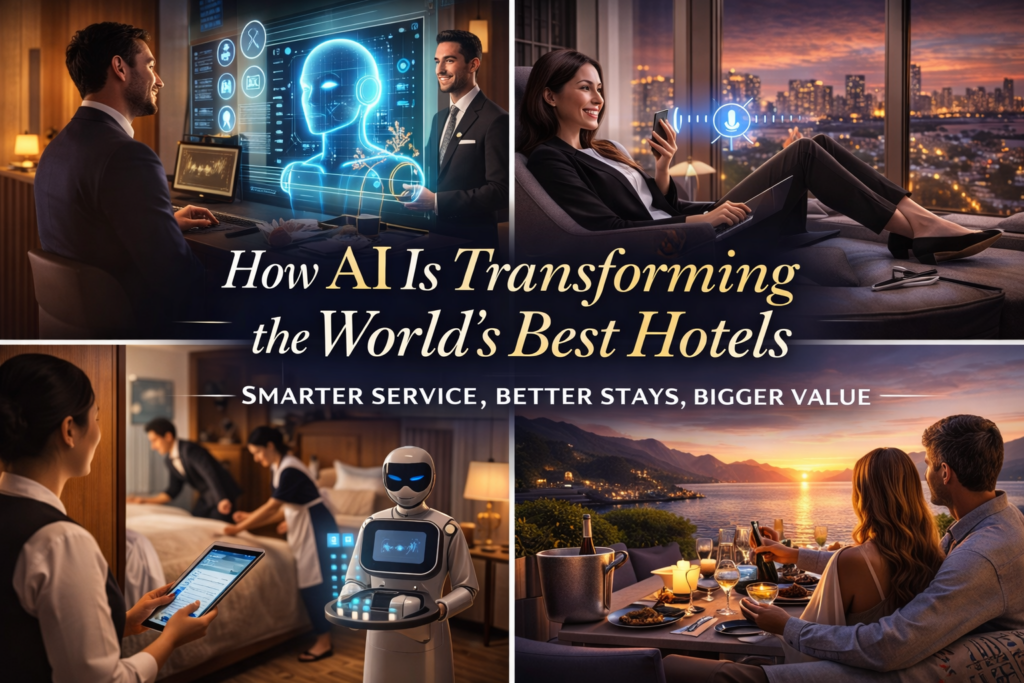
Why AI Has Become a Defining Force in Luxury Hospitality
How AI Is Transforming the World’s Best Hotels, artificial intelligence is no longer a futuristic concept in the hotel industry. In 2026, it is becoming one of the most important forces shaping how the world’s best hotels sell rooms, serve guests, manage staff, optimize pricing, and protect margins. The strongest luxury hotels are not adopting AI simply because it sounds innovative. They are adopting it because the economics and guest expectations now make that move hard to avoid.
BCG’s 2026 analysis of AI-first hotels says AI is already delivering measurable gains in cost efficiency, revenue growth, productivity, talent management, and guest experience. PwC’s 2026 hospitality outlook echoes that pattern, describing AI adoption as an accelerating force behind scalable personalization, dynamic pricing, operational efficiency, profitability, and guest engagement. In plain terms, AI is helping top hotels become faster, sharper, and more profitable without necessarily making the experience feel robotic. In the best cases, it does the opposite. It makes service feel smoother and more human because repetitive work happens quietly in the background.
This matters especially at the high end of the market, where guests are not just paying for a room. They are paying for ease, anticipation, personalization, and emotional confidence. Hilton’s official 2026 trends report says travelers are increasingly prioritizing comfort, control, and connection, and that broader shift helps explain why AI is becoming so valuable in hospitality. If a luxury traveler wants a hotel that remembers their room preferences, adapts offers intelligently, simplifies trip planning, reduces friction at arrival, and delivers faster service without endless waiting, AI becomes a practical tool rather than a buzzword. That is also why this topic carries strong high-CPC advertising value. It sits at the intersection of AI software, enterprise technology, luxury travel, revenue management, hotel operations, customer experience, and business automation. Those are exactly the kinds of categories where advertisers tend to pay more for qualified attention.
How AI Is Making Hotel Service Smarter, Faster, and More Personalized
One of AI’s biggest advantages in luxury hospitality is its ability to make service feel more individualized at scale. That sounds almost contradictory, because “scale” and “personalization” usually pull in opposite directions. Yet AI helps leading hotels bridge that gap by analyzing guest preferences, booking patterns, past stays, ancillary purchases, and contextual data to create more relevant interactions.
BCG notes that AI is already enriching both customer and employee experiences, while EHL’s 2026 hospitality trends coverage highlights AI’s growing role in personalized guest experiences. In practice, that can mean smarter pre-arrival communication, better upsell timing, more accurate preference tracking, improved itinerary suggestions, and more responsive digital concierge support. Instead of treating every guest like a blank slate, AI gives hotels a memory system that can make repeat stays feel much more seamless. That is a major competitive advantage in luxury hospitality, where remembered preferences often matter as much as marble bathrooms and skyline views.
Hilton has already moved visibly in this direction with the launch of its Hilton AI Planner, which the company announced in March 2026. According to Hilton, the tool is designed to help visitors to hilton.com explore stays and plan trips with conversational assistance, and access was scheduled to expand across site visitors during March 2026.
That move is important because it shows how hotel brands are pushing AI beyond back-office operations and into the guest-facing planning journey itself. Marriott is moving in a similar direction. Reporting on the company’s 2025 earnings comments said Marriott planned to deploy natural language search across Marriott.com and the Bonvoy app in the first half of 2026 and was optimizing content for AI-driven discovery so its hotels remain visible wherever and however consumers search. Together, these developments suggest that AI is not just changing the stay. It is reshaping how premium travelers discover, compare, and commit to luxury hotels before they even arrive.
How AI Improves Hotel Operations, Revenue, and Staff Performance
Behind the scenes, AI may be even more powerful than it is at the front end. Great hotels often look effortless to guests, but that smoothness depends on extraordinary operational discipline. AI is increasingly helping hotel operators forecast demand, optimize rates, improve labor deployment, identify service bottlenecks, reduce waste, and respond faster to changing conditions. EHL’s 2026 hospitality trends article states that AI for revenue management can increase profits by analyzing historical data to predict future demand and improve inventory and staffing decisions. PwC’s 2026 outlook also highlights AI’s growing role in dynamic pricing and profitability. In a business where labor costs, occupancy patterns, ADR, and guest expectations are constantly shifting, that predictive edge matters. AI gives hotels a more intelligent way to balance room rates, staffing levels, and ancillary revenue strategies without relying purely on manual judgment or lagging reports.
The staff side is just as important. Luxury hospitality depends on people, and AI works best when it helps those people perform at a higher level rather than trying to replace them outright. EHL specifically points to predictive scheduling, peak-stress anticipation, and absenteeism pattern analysis as ways AI can improve employee well-being. BCG likewise frames AI as a driver of productivity and talent improvement, not just efficiency. That is crucial because elite hotels do not win by cutting service too far.
They win by freeing human staff from repetitive and low-value tasks so they can spend more time on meaningful guest interaction. Think of AI as an invisible operations coach. It helps leadership see demand patterns sooner, assign resources more intelligently, and reduce unnecessary friction. When used well, that translates into better service consistency, faster issue resolution, and a hotel team that can focus more on hospitality and less on administrative drag.
Where AI Creates Better Stays for Hotel Guests
For guests, the most successful AI is often the AI they barely notice. The point is not to make a hotel feel like a science experiment. The point is to remove friction so the stay feels calmer, faster, and more intuitive. In hospitality, the biggest pain points are often small but cumulative: confusing trip planning, slow response times, impersonal offers, room mismatches, poor timing, repetitive requests, and operational delays that guests should never have to think about. AI can reduce those frictions through better digital planning, more precise service triggers, more relevant recommendations, and smarter integration between systems. Hilton’s 2026 trends research emphasizes that travelers increasingly want control and connection, while its “Hushpitality” theme points to rising demand for quiet, restorative experiences. AI can support exactly that kind of outcome by helping hotels personalize without overcomplicating, streamline without depersonalizing, and anticipate without overwhelming.
This is especially relevant in the luxury segment, where guest expectations are not generic. A honeymoon couple, a solo wellness traveler, a business executive, and a multi-generational family all define a “better stay” differently. AI helps hotels recognize those distinctions earlier and act on them more consistently. One guest may value a spa-focused itinerary, another fast room readiness and late check-out options, another child-friendly dining recommendations, and another privacy above all else. AI can surface those needs faster and support better decisions around offers, communications, staffing, and service priority. BCG’s 2026 view that AI-first hotels are becoming richer in customer experience captures this well. The real luxury is not technology for its own sake. The real luxury is relevance. It is the feeling that the hotel understands what kind of trip you are taking and adjusts the experience accordingly. That is where AI creates a genuinely better stay.
How AI Increases Value for Luxury Hotels and Travelers
Value in luxury hospitality is a complex word. It does not mean cheap, and it does not mean stripped-down efficiency. In the context of premium hotels, value means a better ratio between what is paid and what is felt. AI improves that ratio from both sides. For operators, it can sharpen revenue strategy, improve labor efficiency, reduce preventable losses, and lift conversion through better personalization and discovery. For guests, it can improve convenience, speed, relevance, and overall satisfaction. That is why BCG describes AI-first hotels as both leaner and more appealing to customers, while PwC frames AI as a tool for stronger profitability and guest engagement. If a hotel can improve margins while also making the guest journey smoother, that is bigger value in the most meaningful business sense. It is not just cost reduction. It is smarter performance.
There is also a marketing and distribution dimension to this bigger value story. Marriott’s reported push into natural language search and AI visibility shows that hotel brands understand a major new reality: the path to booking is changing. Travelers are no longer searching only through traditional keyword phrases and old comparison flows. They are increasingly discovering travel through conversational search, AI-assisted planning, and ecosystem-driven recommendations. Hilton’s AI Planner reinforces that point from another angle. If hotels can meet travelers in those new discovery environments with better content, smarter planning assistance, and more intuitive booking pathways, they can strengthen direct relationships and potentially reduce dependency on less efficient distribution channels. In other words, AI is not only helping hotels operate better. It is helping them defend and expand where revenue comes from. That is a strategic value layer that goes far beyond a faster chatbot or a shinier app interface.
The Risks, Limits, and Strategic Challenges of AI in Hotels
For all its promise, AI is not automatically positive just because it is new. Hospitality is fundamentally a trust business, and any technology that weakens trust can damage the very value it was meant to create. Hotels have to be careful about privacy, data use, over-automation, poor implementation, staff resistance, and the possibility that guest-facing AI feels cold or incorrect at the exact moment when a human touch is needed most.
Luxury travelers in particular tend to be unforgiving when premium service starts to feel scripted, confusing, or impersonal. That is why the best hotels will not be the ones that automate the most. They will be the ones that automate selectively and intelligently. BCG’s framing of AI as a way to elevate both guest and employee experiences is important here, because it implies a human-centered use case rather than a cost-cutting obsession. AI should support great hospitality, not flatten it into a workflow diagram.
There is also a strategic execution challenge. AI only works well when the underlying hotel systems, data flows, teams, and brand decisions are aligned. Marriott’s recent reporting about overhauling core technology systems and actively investing in AI highlights that transformation is not just about plugging in a tool. It requires infrastructure, migration, governance, and ongoing refinement. Hotels that move too slowly risk falling behind in discovery, personalization, and operating efficiency. Hotels that move too quickly without discipline risk creating fragmented experiences and internal chaos. The winners will likely be brands and properties that treat AI like a long-term operating model, not a short-term marketing stunt. In hospitality, that distinction matters. Guests rarely reward a hotel for simply having advanced technology. They reward the hotel for making the experience feel easier, smarter, and more trustworthy.
What the Future Looks Like for AI in the World’s Best Hotels
The future of luxury hospitality will almost certainly be more AI-enabled, but not less human. That is the central tension shaping the next phase of the industry. The world’s best hotels are unlikely to become fully automated showrooms where every interaction runs through a machine. Instead, the most successful properties will use AI to strengthen the quality of human service by improving timing, context, memory, revenue strategy, and decision support. EHL points to expanding AI use in revenue management, employee well-being, and guest personalization. BCG points to gains across cost, revenue, productivity, and talent. PwC sees AI accelerating across hotel profitability and guest engagement. Those signals point in the same direction: AI is becoming part of the core operating fabric of hospitality, not a side experiment.
For travelers, that future could mean more intuitive planning, more relevant stays, faster service recovery, smarter pricing, and less friction across the entire journey. For hotel brands, it could mean stronger direct booking ecosystems, better labor leverage, more resilient margins, and more powerful personalization at scale. The broader market, it means AI in hotels is moving from trend to competitive necessity. The hotels that embrace it well will likely offer smarter service, better stays, and bigger value. The ones that ignore it may still look beautiful, but beauty alone will not be enough in a market where convenience, relevance, and operational intelligence increasingly define what modern luxury feels like. In the years ahead, the best hotels may not be the ones with the most visible technology. They may be the ones where technology quietly makes everything feel easier, warmer, and more precise.
A Snapshot of Where AI Is Adding the Most Hotel Value
| AI Use Case | How It Helps Hotels | How It Helps Guests |
|---|---|---|
| Trip planning and conversational search | Improves discovery, conversion, and direct booking pathways | Makes planning faster and more personalized |
| Revenue management and forecasting | Optimizes pricing, inventory, and staffing decisions | Can improve availability, timing, and relevance of offers |
| Predictive scheduling and staff analytics | Supports labor efficiency and employee well-being | Leads to smoother, faster, more consistent service |
| Preference-based personalization | Increases upsell precision and repeat-guest value | Makes stays feel more tailored and less repetitive |
| Operational intelligence and friction reduction | Reduces bottlenecks, delays, and unnecessary inefficiency | Creates calmer, easier, more seamless stays |
The patterns in this table are drawn from current 2026 hospitality trend reporting and AI-focused hotel analysis from Hilton, EHL, BCG, PwC, and Marriott-related reporting.
Conclusion
AI is transforming the world’s best hotels because it aligns with what both operators and travelers increasingly want. Hotel companies want better efficiency, stronger revenue, smarter staffing, and more profitable growth. Travelers want easier planning, more personalized service, faster responses, and stays that feel designed around their needs rather than around hotel limitations. The strongest current evidence from Hilton, Marriott-related reporting, EHL, BCG, and PwC suggests that AI is beginning to deliver on both sides of that equation. It is making luxury hospitality more intelligent without requiring it to become less personal.
That is why AI in luxury hotels, smart hotel technology, AI guest experience, hotel revenue optimization, and personalized hospitality are becoming such important topics in both travel and business media. They are not just trends. They are strategic shifts with commercial, operational, and experiential consequences. In the end, the biggest winners will likely be the hotels that use AI with discipline and humanity. They will not simply add more tech. They will use better tech to make hospitality feel more thoughtful, more seamless, and more valuable. And in a premium market where guests expect excellence rather than excuses, that may become the ultimate competitive edge.
FAQ’s
1. How is AI used in luxury hotels today?
AI in luxury hotels is used for personalized guest service, smart booking support, dynamic pricing, predictive staffing, and faster operational decisions. It helps hotels create smoother stays while improving efficiency behind the scenes.
2. Does AI make hotel service less personal?
Not when it is used correctly. The best hotels use AI technology to handle repetitive tasks so staff can focus more on meaningful human interaction, better hospitality, and more personalized guest care.
3. What are the biggest benefits of AI for hotel guests?
The biggest guest benefits include faster service, more relevant recommendations, easier trip planning, smoother check-in experiences, and a stay that feels more tailored to personal preferences.
4. How does AI help hotels increase revenue?
AI helps hotels increase revenue through dynamic pricing, smarter demand forecasting, better upselling, more efficient staffing, and improved direct booking experiences that can support stronger profit margins.
5. What is the future of AI in the hotel industry?
The future of AI in hospitality will likely include deeper personalization, more intelligent service systems, better guest communication, stronger operational efficiency, and a balance between smart automation and human service.