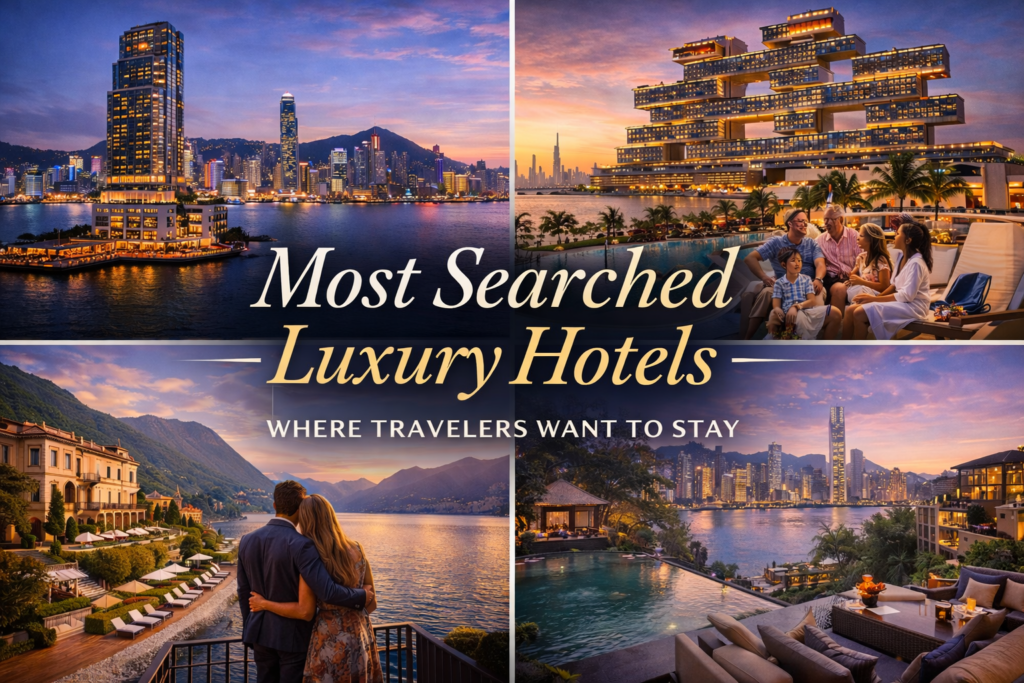
Why “Most Searched Luxury Hotels” Matters in 2026
The phrase most searched luxury hotels in the world is more than a catchy headline. It reflects where global traveler curiosity, aspiration, and booking intent are starting to cluster. There is not one universal public leaderboard that shows every luxury hotel’s exact worldwide search volume across all search engines, travel platforms, and regions in real time. What is publicly visible, though, is a powerful mix of current hotel rankings, luxury travel trend reports, trusted brand data, and traveler behavior research. When those sources point in the same direction, they reveal which properties people are most actively seeking out, reading about, comparing, and dreaming about. In 2026, that matters more than ever because luxury travel is not just about wealth signaling. It is about intentional decision-making, emotional payoff, and a hotel’s ability to become the center of the trip rather than a background detail.
That shift is part of a much larger travel story. UN Tourism reported that international tourist arrivals increased by 4% in 2025 to an estimated 1.52 billion, showing that global travel demand remained resilient. Hilton’s 2026 trends research adds another layer, arguing that travel is increasingly shaped by motivation first, destination second, a pattern it calls the “whycation.” Booking.com’s 2026 predictions also point toward more individualized travel planning, while Expedia’s data-driven travel reporting continues to frame discovery and booking behavior as increasingly shaped by inspiration, personalization, and platform visibility. Put simply, the hotels that dominate search attention today are not just the prettiest or most expensive. They are the properties that sit at the intersection of prestige, trust, cultural relevance, and travel purpose.
What Makes a Luxury Hotel Highly Searched
A luxury hotel becomes highly searched when it does three things at once. First, it has to be globally visible, which usually means strong ranking presence, strong brand recognition, or a standout design and location that makes people talk. Second, it has to be emotionally legible, meaning travelers instantly understand why staying there feels special. Third, it has to be commercially believable, meaning people can picture themselves booking it for a honeymoon, anniversary, family trip, business journey, or once-in-a-lifetime escape. That is why the hotels attracting the most attention are often those appearing repeatedly in trusted luxury ecosystems. Forbes Travel Guide describes itself as the only independent global rating system for luxury hotels, restaurants, spas, and cruises, and says its inspectors assess properties using up to 900 objective criteria during real stays. That kind of institutional validation helps turn admiration into search demand because travelers trust third-party proof more than glossy marketing alone.
Search attention also rises when a hotel reflects broader travel trends. Hilton’s 2026 report shows that travelers increasingly value trusted brands, meaningful experiences, calm environments, and stays that align with the reason for the trip. Expedia’s travel insights similarly frame demand around experience-led planning, while Leading Hotels of the World’s 2025 luxury outlook says demand remains strong for bespoke journeys, immersive culture, and exceptional service. That explains why certain properties repeatedly surface in luxury travel conversations. A high-search hotel is rarely just a room product. It is usually a symbol of something bigger: quiet wellness, iconic architecture, elite dining, private romance, family prestige, or a city-power address. In search behavior, symbolism matters. People type hotel names into search bars when those names start to represent a fantasy they want to test against reality.
The Luxury Hotels Travelers Are Searching for Right Now
One of the clearest indicators of current global attention is The World’s 50 Best Hotels 2025 list. Its official ranking places Rosewood Hong Kong at No. 1, followed by Four Seasons Bangkok at Chao Phraya River, Capella Bangkok, Passalacqua, Raffles Singapore, and Atlantis The Royal. These are not random winners. They are exactly the kinds of properties that tend to dominate traveler interest because each one solves a different luxury desire with exceptional clarity. Rosewood Hong Kong represents urban prestige, skyline drama, and large-scale polished service. Four Seasons Bangkok and Capella Bangkok translate riverside serenity into one of Asia’s most energetic capitals. Passalacqua captures the intimate, cinematic romance of Lake Como. Raffles Singapore embodies timeless heritage. Atlantis The Royal turns modern Dubai spectacle into a destination in itself. When people search for best luxury hotels, most beautiful hotels, top honeymoon hotels, or five-star hotels worth it, these are the kinds of names that repeatedly rise to the top.
Another reason these hotels attract such strong attention is that they sit inside a broader ecosystem of recognition. Forbes Travel Guide’s 2025 and 2026 materials continue to spotlight the rigor of elite luxury validation, while its 2025 awards note the expansion of Five-Star recognition across Asia, the Middle East, and Africa. That widening map matters. Search demand in luxury hospitality is no longer concentrated only in old European icons. Travelers are actively seeking hotels in Hong Kong, Bangkok, Dubai, Singapore, Lake Como, and other destinations that combine status with strong service narratives. This helps explain why Asia remains so dominant in contemporary hotel discourse. It also explains why “most searched” and “most admired” often overlap. Search interest follows the places where hospitality is delivering both excellence and fresh relevance.
Why These Hotels Attract So Much Search Interest
At the top end of hospitality, search behavior is usually driven by a blend of aspiration and specificity. Travelers are not only typing broad phrases like luxury resort or best five-star hotel. They are also searching for names that have become shorthand for a particular travel fantasy. Passalacqua is searched because it represents elegant romance and one of the world’s most photogenic lake settings. Atlantis The Royal attracts attention because it embodies futuristic luxury, high-profile dining, and the kind of visual drama that performs well across editorial coverage and social media. Rosewood Hong Kong pulls interest because it combines brand prestige with a powerful city-harbor identity. In other words, heavily searched luxury hotels usually have strong narrative clarity. People understand the promise immediately, and that accelerates both curiosity and intent.
Trust is just as important as spectacle. Hilton’s 2026 trends reporting emphasizes that travelers increasingly want familiar, dependable brands and stays that align with emotional needs such as rest, reconnection, and control. Booking.com’s 2026 predictions lean in a similar direction, highlighting increasingly personalized journeys. This means search demand now rewards hotels that feel both extraordinary and safe to choose. Travelers want wow factor, but they also want confidence that the experience will actually deliver. That is why elite hotel brands and highly vetted independent properties hold such a strong position in the search economy. The best luxury hotels operate like premium financial assets: they may be emotionally charged, but they still need to signal reliability, consistency, and value at their level of the market.
Most Searched Luxury Hotels by Traveler Type
Different traveler types search differently, which is why the same hotel rarely dominates every luxury query. Couples and honeymoon travelers often search for intimacy, scenery, privacy, and mood, which makes hotels like Passalacqua especially magnetic. Business travelers, on the other hand, are more likely to seek a combination of prestige, efficiency, location, and trusted service, which helps explain the visibility of names such as Rosewood Hong Kong and Four Seasons Bangkok at Chao Phraya River. Families often gravitate toward hotels that combine luxury with range, activity, and visual impact, making Atlantis The Royal a natural attention magnet. Wellness-minded solo travelers increasingly lean toward quieter, more restorative properties, which supports the rising visibility of hotels tied to silence, wellness, and slow design. Search demand is not uniform because luxury itself is not uniform. It bends around purpose.
This is exactly why hotel SEO at the premium end works best when it mirrors real traveler intent. A person searching best honeymoon hotel in the world is often not looking for the same thing as someone searching best luxury business hotel or most beautiful hotel with views. The strongest luxury properties perform across multiple intent layers because they offer more than one benefit at once. A Bangkok riverfront hotel can satisfy both business and wellness intent. A Lake Como villa hotel can satisfy both romance and prestige intent. A high-design Dubai property can satisfy family, luxury, and destination-dining intent all at once. The more versatile and clearly branded the hotel experience becomes, the more search pathways lead back to it. In digital visibility, multi-intent appeal is a huge competitive advantage.
A Quick Comparison of High-Interest Luxury Hotels
To understand why certain names dominate traveler attention, it helps to compare them by what they promise rather than by rate alone. The table below uses current official ranking signals and hotel positioning to show why these properties tend to attract stronger interest than generic five-star inventory. What stands out is that each hotel owns a distinct emotional category. Some own romance. Some own urban prestige, pectacle & timeless heritage. Search visibility follows that clarity because travelers can connect their trip goals to the hotel almost instantly.
| Hotel | Location | Current Global Signal | Why Travelers Search It |
|---|---|---|---|
| Rosewood Hong Kong | Hong Kong | No. 1 on The World’s 50 Best Hotels 2025 | Urban prestige, harbor views, strong luxury brand appeal |
| Four Seasons Bangkok at Chao Phraya River | Bangkok | No. 2 on The World’s 50 Best Hotels 2025 | Riverside calm, business-leisure appeal, trusted brand |
| Capella Bangkok | Bangkok | No. 3 on The World’s 50 Best Hotels 2025 | Quiet luxury, personalized service, wellness atmosphere |
| Passalacqua | Lake Como | No. 4 on The World’s 50 Best Hotels 2025 | Romance, boutique exclusivity, iconic scenery |
| Raffles Singapore | Singapore | No. 5 on The World’s 50 Best Hotels 2025 | Heritage luxury, classic prestige, historic reputation |
| Atlantis The Royal | Dubai | No. 6 on The World’s 50 Best Hotels 2025 | Spectacle, family luxury, destination dining, modern status |
What this comparison shows is that there is no single formula for becoming a highly searched luxury hotel. The common thread is not one architectural style or one region. The common thread is memorability with proof. These hotels give travelers a reason to care, and then they back that up with rankings, awards, trusted operators, and strong media visibility. That combination is powerful because it shortens the decision cycle. Searchers do not feel they are taking a blind risk. They feel they are moving toward a property that has already earned global attention for a reason. In luxury hospitality, perceived certainty can be just as valuable as desire.
Luxury Travel Trends Fueling Hotel Search Demand
The rise in search demand for elite hotels is tightly linked to how luxury travel itself is evolving. Hilton’s 2026 report argues that travelers are prioritizing comfort, control, connection, and more intentional journeys. Booking.com’s 2026 outlook similarly emphasizes individuality and highly personalized travel. Expedia’s travel trend reporting points to travelers discovering and choosing stays through inspiration-led patterns rather than rigid old formulas. Together, these signals suggest that high-search luxury hotels are not simply benefiting from brand advertising. They are benefiting from deeper changes in what people want from travel. Travelers want fewer generic trips and more experiences that feel like self-expression. That naturally benefits standout hotels because standout hotels are easier to imagine, easier to remember, and easier to justify at premium price points.
Luxury hospitality is also being pushed by broader demand for authenticity, wellness, and meaning. Leading Hotels of the World said in its 2025 luxury report that the year was shaping up with strong demand for bespoke travel, immersive culture, and exceptional quality. Forbes Travel Guide’s own coverage of 2025 luxury openings highlighted a shift toward authenticity and well-being. Those are not abstract editorial themes. They are search drivers. A traveler who wants a meaningful stay will search more deeply, compare more carefully, and spend more time evaluating hotel identity rather than just room size. The hotels winning that attention are the ones that combine beauty with story, comfort with credibility, and luxury with emotional purpose. Search, in that sense, becomes a record of desire getting more precise.
How to Choose the Right Luxury Hotel from the Search Hype
Being one of the most searched luxury hotels in the world does not automatically mean a property is right for every traveler. Search heat can signal prestige and relevance, but the smarter question is whether the hotel fits the reason for the trip. A couple planning an anniversary may be better served by a boutique romantic icon such as Passalacqua than by a giant destination complex. A business traveler may get more value from the location, service discipline, and quiet efficiency of Rosewood Hong Kong or Four Seasons Bangkok. A family may prefer the energy and range of Atlantis The Royal. The most useful way to read search popularity is as a shortlist, not a final answer. It tells you where the world is looking. It does not tell you, by itself, where you personally should stay.
The smartest travelers use current rankings and trusted evaluation systems as filters, then match those filters to their own priorities. Forbes Travel Guide’s inspection-based approach is useful when service validation matters. The World’s 50 Best Hotels is useful when you want a snapshot of current admiration and global relevance. Trend reports from Hilton, Booking.com, and Expedia help explain what kinds of stays are resonating with travelers more broadly. Once you bring those layers together, search hype becomes much more valuable. It stops being noise and starts becoming intelligence. The best luxury hotel is not simply the one everyone is searching for. It is the one that turns your specific reason for traveling into an unforgettable stay.
Conclusion
The most searched luxury hotels in the world are usually the properties that combine visibility, trust, design, and emotional relevance better than anyone else. In the current landscape, names such as Rosewood Hong Kong, Four Seasons Bangkok at Chao Phraya River, Capella Bangkok, Passalacqua, Raffles Singapore, and Atlantis The Royal stand out because they align with where high-end travel is going. Travelers want stays that feel purposeful, memorable, and reliable. They want hotels that are beautiful, yes, but also emotionally clear. The current mix of official rankings and travel trend data suggests that search demand is increasingly rewarding hotels that tell a strong story and deliver on it.
That is why this topic carries such strong editorial and commercial value. People searching these hotels are often not casual browsers. They are high-intent travelers looking at premium experiences across flights, finance, dining, wellness, and lifestyle. For that reason, luxury hotel search behavior is one of the clearest windows into where aspirational travel spending is headed. And right now, it is headed toward hotels that feel less like generic luxury inventory and more like destinations with personality, proof, and a reason to be chosen.