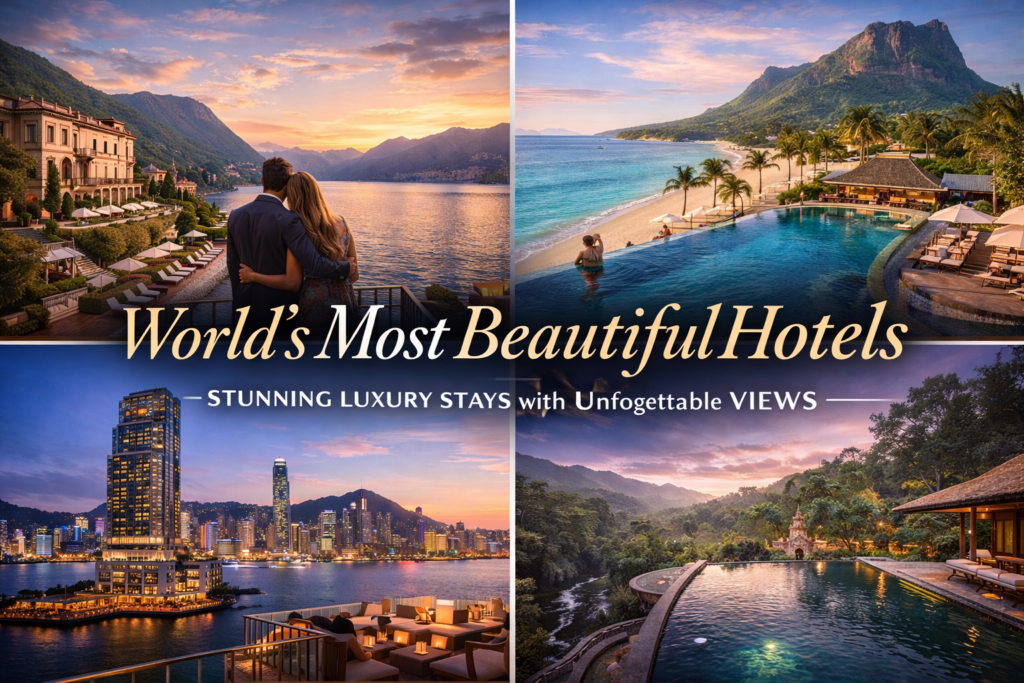
Why Beautiful Hotels Matter More Than Ever in Modern Luxury Travel
The idea of a beautiful hotel has changed dramatically. It is no longer enough for a property to have a grand lobby, a famous address, or expensive finishes. In 2026, the world’s most beautiful hotels are judged by how completely they blend architecture, landscape, comfort, privacy, service, and emotional atmosphere into one seamless experience. The strongest properties do not simply look impressive in photographs. They shape the traveler’s mood from the moment of arrival. That is why current hospitality rankings matter so much. Forbes Travel Guide says it evaluates properties using up to 900 objective criteria, and its 2026 awards platform describes itself as the only independent global rating system for luxury hotels, restaurants, spas, and cruises. In 2025, Forbes Travel Guide’s awards spanned more than 2,100 properties in 90 countries, including 336 Five-Star hotels, which shows just how selective truly exceptional hospitality remains. A beautiful hotel, then, is not just a visual product. It is a performance of design, discipline, and emotional intelligence.
That shift matters because luxury travel is becoming more intentional and more experience-led. UN Tourism reported that international tourist arrivals rose by 4% in 2025 to an estimated 1.52 billion, showing that global travel demand remains resilient and that premium travel decisions still matter at scale. At the same time, Hilton’s official 2026 Trends Report argues that travelers are increasingly choosing trips based on purpose before destination, a movement it calls the “whycation.” This is especially relevant for scenic luxury hotels because travelers are now asking more focused questions: Do they want a dramatic oceanfront escape, a mountain sanctuary, a riverside urban retreat, or a heritage property with iconic architectural beauty? The best hotel content and the best hotel brands understand that beauty has become strategic. It is not decoration around the trip. It is often the reason the trip is booked in the first place.
What Makes a Hotel Truly Beautiful, Not Just Expensive
A truly beautiful hotel does more than display wealth. It creates harmony between setting and experience. Some properties achieve this through cinematic views, some through heritage design, some through quiet intimacy, and others through dramatic scale. The current World’s 50 Best Hotels 2025 ranking illustrates how varied beauty can be. Rosewood Hong Kong, ranked No. 1, captures a sleek urban waterfront elegance. Passalacqua in Lake Como, ranked No. 4, expresses beauty through intimacy, classical romance, and landscape. Atlantis The Royal in Dubai, ranked No. 6, turns monumental architecture into spectacle. Mandapa in Bali, which entered the 2025 list, is described by the ranking’s official site as a “village within a village,” hidden in Ubud’s lush hills and designed around serenity along the Ayung River. These examples show that the best luxury hotels with unforgettable views are not copies of one another. They are distinct answers to the same question: how do you make a place unforgettable?
Beauty in hospitality also depends on restraint. The finest hotels know when to impress and when to disappear into the guest’s experience. A panoramic suite means little if the lighting is harsh, the room acoustics are poor, or the service feels mechanical. This is why elite properties increasingly pair aesthetics with atmosphere. Hilton’s 2026 trend theme of “Hushpitality” highlights growing demand for silence, calm, and environments that reduce distraction. That matters because guests are no longer looking only for a place that photographs well. They want a place that lets them breathe. A mountain-view villa, a lakeside terrace, or a river-facing suite becomes far more powerful when it is paired with stillness, privacy, and service that feels intuitive rather than intrusive. In that sense, the world’s most beautiful hotels operate like great cinema. The scenery draws you in, but the pacing, emotion, and invisible craft are what make the experience stay with you.
The World’s Most Beautiful Hotels Right Now
If you want a current, globally relevant shortlist of beautiful hotels, the official World’s 50 Best Hotels 2025 ranking offers one of the strongest reference points. The top of the list includes Rosewood Hong Kong, Four Seasons Bangkok at Chao Phraya River, Capella Bangkok, Passalacqua, Raffles Singapore, Atlantis The Royal, and Mandarin Oriental Bangkok. What makes this lineup especially useful is that it spans several forms of beauty. Some of these hotels are urban and vertical, with skyline or riverfront drama. Others are historic, romantic, or rooted in landscape. Together, they show that global admiration no longer belongs only to one region or one style of design. Asia remains incredibly strong, heritage hotels still command enormous respect, and destination architecture continues to win when it is backed by elite service.
Among these names, Passalacqua stands out for travelers searching for stunning luxury stays with unforgettable views because Lake Como has a natural cinematic advantage, and the property transforms that setting into an intimate luxury story rather than a generic resort stay. Atlantis The Royal offers the opposite type of beauty: bold scale, modern engineering, and a Dubai setting that feels intentionally theatrical. Rosewood Hong Kong proves that urban hotels can be just as visually powerful as remote resorts when the architecture, interiors, and harbor views work together. Four Seasons Bangkok at Chao Phraya River and Capella Bangkok make the river feel like an emotional anchor inside a major city. These hotels are not beautiful in the same language, but they all understand composition. Every line, view, material, and moment is arranged to create impact without chaos. That is what separates a beautiful hotel from a merely impressive one.
Best Beautiful Hotels for Ocean, Lake, and Waterfront Views
Water remains one of the strongest luxury assets in global hospitality because it changes both the visual experience and the emotional rhythm of a stay. Hotels with ocean views, lakefront views, river views, or private beach access often command higher interest because water creates movement, light variation, and a sense of spaciousness that static cityscapes sometimes cannot match. The current 2025 ranking shows exactly how powerful waterfront settings remain. Rosewood Hong Kong benefits from Victoria Harbour’s dramatic skyline interplay. Four Seasons Bangkok at Chao Phraya River and Capella Bangkok use the river not as background decoration but as atmosphere. Passalacqua turns Lake Como into a central character, making the hotel feel less like accommodation and more like a living postcard. Even Atlantis The Royal uses pools, waterfront framing, and Dubai’s coastal environment to reinforce its visual identity.
What makes waterfront hotels especially compelling is that they fit multiple travel intentions at once. They work for romantic travel, wellness travel, premium family vacations, and luxury business stays. A lake or river creates calm. An oceanfront view can feel expansive and restorative. That emotional versatility is extremely valuable in current travel behavior, because travelers are increasingly choosing trips based on why they are traveling rather than simply where they are going. The whycation idea from Hilton’s 2026 research fits this perfectly. A traveler who wants to reconnect, celebrate, decompress, or simply escape overstimulation is often drawn to water first. Scenic hotels understand this instinct. They do not just sell rooms with views. They sell mental space. And in a travel market that remains strong and highly competitive, mental space has become one of the most desirable luxury products available.
Best Beautiful Hotels for Mountain, Nature, and Wellness Escapes
Not every traveler wants glamour framed by glass and skyline lights. Some want beauty that feels quieter, softer, and more rooted in the landscape. This is where mountain resorts, jungle retreats, and wellness-led properties become especially powerful. Official coverage for Mandapa describes it as a sanctuary along the Ayung River in Bali, hidden in Ubud’s lush hills and designed as a “village within a village,” with just 35 suites and 25 private pool villas. That kind of scale matters. It suggests privacy, intimacy, and a slower rhythm, which are all central to the growing quiet-luxury movement in travel. A nature-based hotel does not need the grandest architecture in the world if it knows how to work with light, vegetation, water, and local materials. Often, the most beautiful effect comes from feeling that the hotel belongs to its setting rather than trying to dominate it.
This category is becoming more important because modern travelers increasingly associate beauty with well-being. Hilton’s trends reporting shows that travelers in 2026 are seeking calm, connection, and more meaningful journeys, while Hushpitality points directly to demand for quieter environments and restorative experiences. That makes mountain and nature hotels especially relevant for travelers searching terms like best wellness hotels, beautiful spa resorts, luxury eco retreats, or peaceful five-star resorts. A hotel surrounded by forest, rice terraces, cliffs, or highland air can feel beautiful in a way that is more physical than visual. You feel it in your breathing, your sleep, your appetite, and your pace. The best nature hotels understand this. They are not only scenic. They are regulating, lower the temperature of daily life and help the guest return to themselves.
Best Beautiful Hotels for Every Type of Traveler
One of the biggest mistakes in hotel writing is treating beauty as if it means the same thing for everyone. It does not. For a couple planning an anniversary, beauty may mean a romantic terrace, dramatic sunset, and quiet intimacy. For a family, beauty may include spacious design, memorable pools, and a setting that feels exciting without becoming stressful. Business traveler, beauty can mean an elegant city hotel with commanding views and enough serenity to recover after a demanding day. Solo traveler, beauty may be found in wellness rituals, calm spaces, and architecture that makes being alone feel peaceful rather than empty. The top current ranking helps reveal these differences. Passalacqua is ideal for romance. Atlantis The Royal suits travelers who want spectacle and range. Rosewood Hong Kong and Four Seasons Bangkok at Chao Phraya River work beautifully for urban luxury and premium business-leisure trips. Mandapa fits solo travelers and wellness-minded guests particularly well.
This traveler-by-traveler approach is also stronger from an SEO perspective because best beautiful hotels is not one single search intent. It branches into best honeymoon hotels, best hotels with views, best family luxury resorts, best wellness resorts, best boutique hotels, and best business hotels. A professional hotel article should reflect that structure because readers do not want abstract admiration alone. They want help choosing. Beauty becomes useful when it is matched to purpose. The best hotels in the world win because they make that match easier. They speak clearly to a traveler’s dream while also satisfying practical needs like location, privacy, service, and atmosphere. The most effective luxury hotel content mirrors that same balance. It inspires first, but it also guides.
Quick Comparison of Beautiful Hotels with Unforgettable Views
The easiest way to understand how different kinds of hotel beauty serve different travelers is to compare them side by side. The table below uses official 2025 global ranking information and hotel descriptions to show how leading properties fit different view-driven and experience-led travel preferences.
| Hotel | Location | Current Recognition | Beauty Style | Best For |
|---|---|---|---|---|
| Rosewood Hong Kong | Hong Kong | No. 1, World’s 50 Best Hotels 2025 | Urban harbor glamour | Luxury city breaks, business travel, skyline lovers |
| Four Seasons Bangkok at Chao Phraya River | Bangkok | No. 2, World’s 50 Best Hotels 2025 | Riverside modern elegance | Business-leisure travel, design lovers, calm in the city |
| Capella Bangkok | Bangkok | No. 3, World’s 50 Best Hotels 2025 | Quiet riverfront refinement | Solo travel, wellness, privacy |
| Passalacqua | Lake Como | No. 4, World’s 50 Best Hotels 2025 | Romantic lakeside classic beauty | Honeymoons, couples, boutique luxury |
| Raffles Singapore | Singapore | No. 5, World’s 50 Best Hotels 2025 | Heritage grandeur | Historic luxury, prestige travel |
| Atlantis The Royal | Dubai | No. 6, World’s 50 Best Hotels 2025 | Monumental architectural spectacle | Families, destination stays, modern luxury |
| Mandapa | Bali | New entry on World’s 50 Best Hotels 2025 | Jungle-river serenity | Wellness, nature escapes, solo luxury |
This comparison highlights an important truth: there is no single “best-looking” hotel in the world in any universal sense. There are only hotels whose beauty aligns more closely with a traveler’s intent, taste, and emotional goal. That is why rankings are useful but not sufficient by themselves. A traveler still has to ask whether they want the energy of Hong Kong, the softness of Lake Como, the grandeur of Dubai, the rhythm of Bangkok, or the serenity of Bali. Once that question is answered, the shortlist becomes much smarter and much more personal.
How to Choose the Most Beautiful Hotel for Your Next Trip
Choosing the right beautiful luxury hotel should begin with the type of view and feeling you want, not just the fame of the property. If your ideal trip involves city energy and skyline drama, an urban icon like Rosewood Hong Kong may be more compelling than a remote resort. If you want romance, a lakeside property such as Passalacqua is likely to create stronger emotional payoff. You want stillness and wellness, a nature-based retreat such as Mandapa may deliver more than a flashy beach complex. Current travel behavior supports this more intentional way of choosing. Hilton’s 2026 research emphasizes motivation-led travel, while UN Tourism’s latest figures confirm that demand remains strong enough for travelers to be more selective about how and where they spend. In other words, travelers do not just want a beautiful room. They want a beautiful fit.
It also helps to lean on credible evaluation systems instead of relying only on social media imagery. Forbes Travel Guide remains valuable because its inspections are based on extensive criteria and real stays rather than marketing language alone. The World’s 50 Best Hotels list is useful because it captures current prestige and admiration across global hospitality. When these signals align with your travel style, you are more likely to find a hotel that feels genuinely special instead of merely expensive. Think of it this way: a beautiful hotel should not feel like a postcard you briefly occupy. It should feel like a place that improves the story of the trip itself. The best ones do exactly that. They do not just give you a view. They give that view meaning.
Conclusion
The world’s most beautiful hotels are not simply the ones with the biggest chandeliers, the highest rates, or the most viral photographs. They are the properties that combine architecture, setting, service, and emotional atmosphere so smoothly that the stay feels unforgettable. Current 2025–2026 hotel signals point to a rich and diverse luxury landscape: waterfront icons like Rosewood Hong Kong, Four Seasons Bangkok at Chao Phraya River, and Capella Bangkok; romantic classics like Passalacqua; historic legends like Raffles Singapore; spectacular modern statements like Atlantis The Royal; and nature-led sanctuaries like Mandapa. These hotels are beautiful for different reasons, but they all succeed because they understand that beauty in hospitality is not surface alone. It is experience, memory, and meaning working together.
For travelers, this matters because the right beautiful hotel can change the entire shape of a trip. For publishers and advertisers, it matters because this topic sits at the crossroads of high-intent search behavior and premium spending categories like luxury travel, fine dining, wellness, finance, and lifestyle. That is why scenic luxury hotel content remains so commercially powerful. People searching for the most beautiful hotels in the world are not just daydreaming. Very often, they are preparing to invest in an experience that reflects how they want to live, celebrate, recover, or be seen. The best hotels understand that aspiration. And the very best of them turn it into reality with breathtaking views, world-class service, and design that stays in the mind long after checkout.
FAQs
1. What is the most beautiful hotel in the world right now?
There is no single official beauty ranking, but the current World’s 50 Best Hotels 2025 list names Rosewood Hong Kong as the world’s best hotel overall.
2. Which beautiful hotel is best for couples?
Passalacqua in Lake Como is one of the strongest current choices for romance, intimate luxury, and unforgettable lake views.
3. Which beautiful hotel is best for wellness and nature?
Mandapa in Bali stands out for travelers seeking river views, lush natural surroundings, privacy, and a wellness-oriented atmosphere.
4. Why are hotels with views so popular now?
Current travel trends show travelers are increasingly choosing trips based on purpose, calm, and emotional reward, which makes scenic hotels especially appealing.
5. How should travelers choose a beautiful hotel?
Start with your travel purpose, then compare view style, setting, privacy, service, and trusted rankings instead of relying on photos alone.